

Home › Utility Bill Learning Center › Electricity Bill Charges Explained
Electricity bills usually contain more than a single price per kWh. Current electricity charges can include an energy or supply charge, transmission and distribution or delivery charges, a fixed customer charge, tariff riders or adjustments, taxes and fees, minus any applicable credits.
This is why an advertised electricity rate can be lower than the effective cost of the complete current electricity bill.
=
Supply / Energy Charges
+
Transmission / Distribution / Delivery
+
Fixed Customer Charges
+
Tariff Riders / Adjustments
+
Taxes / Fees
-
Current Credits
Some utilities combine several network-related costs under “delivery.” Others show transmission, distribution and additional adjustments separately. Always use the issuing provider's current tariff for a real account.
UtilityBillGenerator.net creates fictional sample electricity bills only.
Samples are intended for legitimate software testing, OCR, UI/UX design, demonstrations, education and training. They are not official provider records and are not proof of electricity service, account ownership, payment, address or identity.
Electricity Charge Breakdown Calculator
Use this educational calculator to see how usage-based electricity charges, fixed charges, adjustments and credits can combine into a current-period total.
This calculator demonstrates simplified arithmetic. It does not validate a real electricity bill or determine whether a provider's tariff was applied correctly.
Tiered rates, time-of-use pricing, minimum bills, demand charges and tariff-specific riders may require more complex calculations than this simplified example.
If you first need help locating these items on the statement, read How to Read an Electricity Bill .
For the general relationship between usage, rates and charges, see How Are Utility Bills Calculated? .
Supply vs Delivery Charges: What Is the Difference?
If you are reviewing charge fields against a fictional statement for testing, training or a document mockup, the online utility bill sample creator provides a broader starting point before working with an electricity-specific template.
A useful way to understand many electricity bills is to separate the cost of the electricity itself from the cost of moving that electricity through the grid and serving the account.
| Supply / Generation | Delivery |
|---|---|
| Relates to electricity generation or procurement. | Relates to moving electricity through transmission and local distribution infrastructure. |
| Often varies with kWh consumed. | Can contain both usage-based and fixed components. |
| May sometimes come from a competitive supplier. | Usually remains associated with the local distribution utility. |
| Can change with energy-market or tariff conditions. | Can include regulated infrastructure, metering and service costs. |
Massachusetts' current consumer guidance, for example, separates electric bills into supply and delivery components and explains that delivery can include transmission, distribution and other delivery charges.
What Is an Electricity Supply or Generation Charge?
If you first need help locating usage, meter readings, billing dates and the individual charge sections on a statement, see our guide to reading an electricity bill.
The electricity supply or generation charge generally represents the energy commodity or cost associated with producing or procuring the electricity consumed.
=
Supply Charge
Fictional example
=
$67.36 supply charge
What Is a Transmission Charge?
Transmission relates to moving electricity across higher-voltage portions of the grid before it reaches local distribution networks.
Depending on the provider and tariff, transmission can appear as:
- a separate line item;
- part of a broader delivery charge;
- part of another tariff-defined network charge.
What Is a Distribution Charge?
Distribution charges generally relate to the local system that delivers electricity to homes and businesses.
These costs can support:
- local wires and poles;
- substations and transformers;
- metering;
- billing systems;
- customer service;
- system operation and maintenance.
A distribution tariff can include both a fixed customer charge and usage-based per-kWh charges.
What Is a Delivery Charge on an Electricity Bill?
“Delivery” is often a broader label covering the costs of moving electricity to the service location.
Depending on the utility, delivery can include:
- transmission;
- distribution;
- metering;
- customer-service costs;
- fixed charges;
- tariff adjustments;
- certain taxes or infrastructure-related charges.
What Is a Customer Charge or Fixed Charge?
A customer charge is a recurring charge that does not directly increase or decrease with each additional kWh consumed.
Fixed charges can help recover account and service costs even when electricity consumption is very low.
Why can a bill still cost money with almost no usage?
Customer charge: $9.00
Other applicable fees: $1.20
Total: $10.20
Fixed vs Variable Electricity Charges
| Charge | Typical Cost Type | What Changes It? |
|---|---|---|
| Supply / generation | Usually variable | kWh and applicable rate |
| Per-kWh distribution | Variable | kWh consumed |
| Customer charge | Fixed | Usually rate schedule, not kWh |
| Minimum charge | Fixed or floor | Tariff terms |
| Demand charge | Demand based | Billed kW / tariff rules |
| Rider | Varies | Tariff-specific formula |
| Tax / fee | Varies | Jurisdiction and calculation method |
| Credit | Varies | Program or account activity |
What Is a Minimum Electricity Charge?
Some tariffs establish a minimum amount that can apply even when calculated usage-based charges would otherwise be lower.
A minimum charge is not the same thing as a customer charge, although both can keep a low-usage statement above zero.
What Are Riders and Adjustments on an Electric Bill?
Providers may use different names or abbreviations for riders, adjustments, regulatory fees and other line items. Use our utility bill terms and abbreviations guide when a charge label is unfamiliar.
A rider is generally a tariff-defined charge or credit applied in addition to a base electricity rate.
| Possible Label | General Purpose |
|---|---|
| Fuel Adjustment | Can reconcile fuel or purchased-energy costs. |
| Generation Adjustment | Can adjust electricity supply or generation-related costs. |
| System Benefits Charge | Can support designated energy or public-benefit programs. |
| Renewable / Clean Energy Charge | Can support jurisdiction-specific clean-energy programs. |
| Transition Charge | Can recover jurisdiction-specific legacy or restructuring costs. |
| Revenue Adjustment | Can reconcile authorized revenue under certain tariff structures. |
What Taxes and Fees Can Appear on an Electricity Bill?
Electricity bills may contain taxes, regulatory assessments or other jurisdiction-specific fees.
They may be:
- shown as separate line items;
- calculated as percentages;
- based on certain portions of the bill;
- embedded within another charge category.
What Credits Can Reduce Electricity Charges?
Credits reduce the account or current-period charge total.
Examples can include:
- billing corrections;
- energy-assistance credits;
- promotional credits;
- solar or export credits;
- provider-specific program credits.
Why Is My Electricity Delivery Charge So High?
A delivery charge can be larger than the supply charge because the delivery side may contain several cost components rather than one simple rate.
High-voltage grid costs may be included.
Local wires, poles, substations and system operation.
Monthly account charges can apply regardless of kWh.
Tariff adjustments can increase or reduce delivery-side totals.
Some charges can be embedded in delivery depending on the jurisdiction.
Usage-based distribution charges can increase as kWh increases.
Why Did My Electricity Bill Stay High When kWh Went Down?
Lower electricity usage does not guarantee that every part of the bill falls by the same percentage.
- supply charge;
- per-kWh distribution;
- some usage-based riders;
- some taxes calculated from usage charges.
- fixed customer charge;
- minimum charge;
- flat fees;
- demand charges;
- some tariff riders.
Simple example
Fixed customer charge: still $10
The usage-dependent portion can decline while the fixed portion remains unchanged.
Why Is My Effective Cost per kWh Higher Than My Supply Rate?
To see how usage, rates, fixed charges, taxes, credits and adjustments combine mathematically, review how utility bills are calculated.
The energy supply rate may describe only one component of the complete electricity bill.
=
Effective Current-Electricity Cost per kWh
Fictional example
| Component | Amount |
|---|---|
| Supply | $67.36 |
| Variable delivery | $33.68 |
| Customer charge | $9.00 |
| Rider | $0.72 |
| Taxes / fees | $4.71 |
| Total | $115.47 |
The supply rate is only 8.00 cents/kWh in this fictional example, but the complete current electricity cost is higher because delivery, fixed charges, adjustments and taxes are also included.
Do not include unrelated past-due balances, deposits, late fees or non-electric utility services in the numerator when calculating current-electricity cost per kWh.
Why Fixed Charges Matter More When Usage Is Low
The same fixed charge has a much larger effect on effective cost per kWh when electricity consumption is low.
Usage: 1,000 kWh
Fixed charge: $10
Usage: 100 kWh
Fixed charge: $10
The fixed charge itself did not change. Its effective impact per unit of electricity did.
What Is a Demand Charge?
A demand charge is different from an energy charge.
| Charge | Typical Billing Unit | Measures |
|---|---|---|
| Energy charge | $/kWh | Total electricity consumed over time. |
| Demand charge | $/kW | Peak or billed demand under the applicable tariff. |
Why Can Supply and Delivery Come From Different Companies?
In some electricity markets, customers can obtain electricity supply from a competitive supplier while the local distribution utility continues delivering the electricity.
In those situations:
- the supplier can determine the supply product or price under the applicable market rules;
- the local utility still operates the distribution system;
- supply and delivery charges can appear on one bill or, in some arrangements, separate bills.
12-Step Electricity Charge Audit Checklist
- Confirm billed kWh. Make sure you know the electricity usage being charged.
- Find the rate plan. Identify the tariff or service class.
- Separate supply from delivery. Do not treat every charge as one electricity rate.
- Check the supply rate. Determine whether it is flat, tiered or time dependent.
- Review transmission charges. Check whether they are separate or included in delivery.
- Review distribution charges. Identify usage-based and fixed portions.
- Find the customer charge. Separate fixed costs from kWh-dependent costs.
- Review riders and adjustments. Use the provider's tariff definitions.
- Check taxes and fees. Identify whether they are separate or embedded.
- Review credits. Make sure reductions are included in the net total.
- Recalculate visible arithmetic. Use the breakdown calculator as a basic cross-check.
- Compare effective cost per kWh. Use current electricity charges only for a cleaner comparison.
How Charges Work in a Sample Electricity Bill
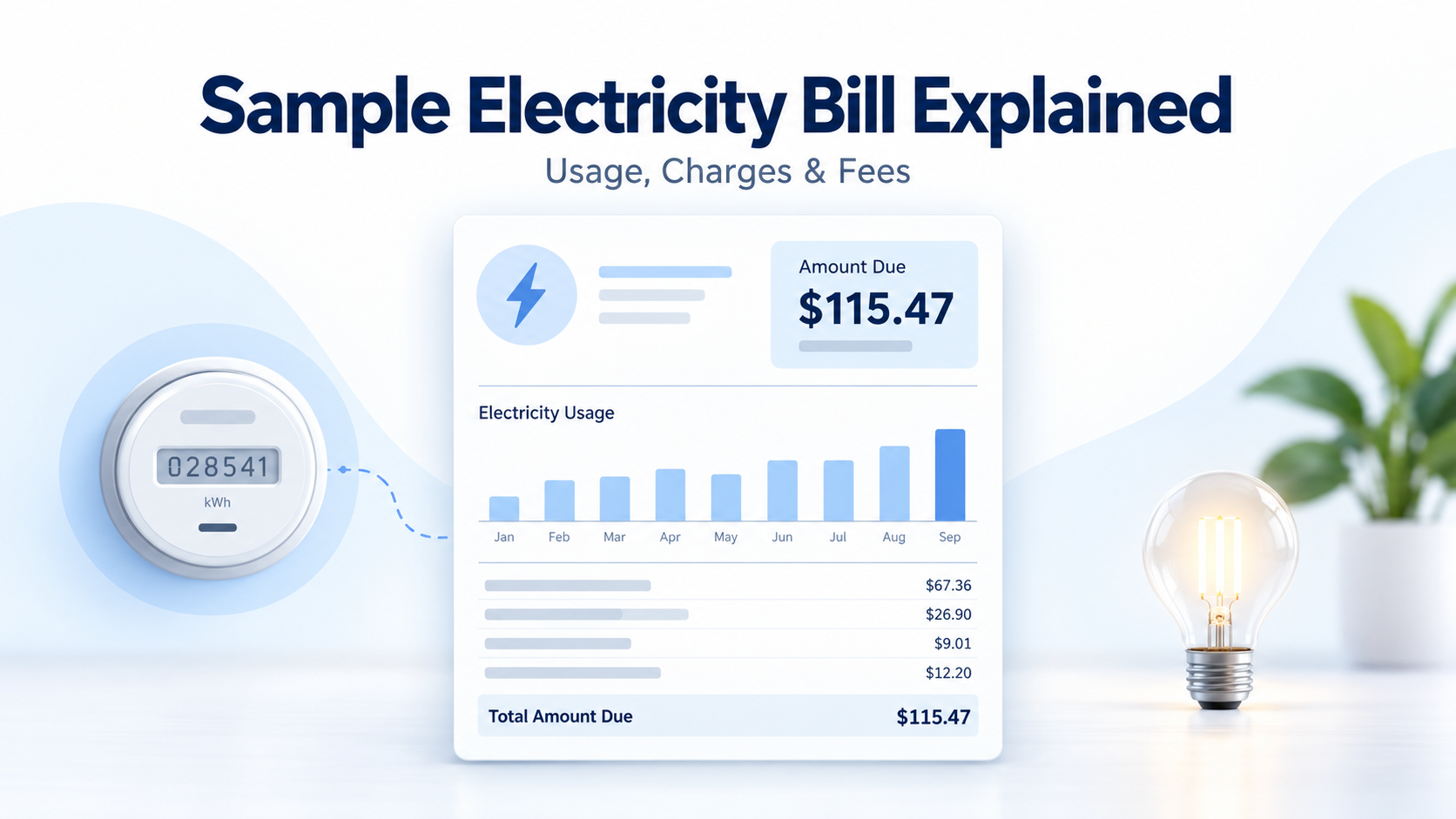
For a complete fictional example, see our annotated sample electricity bill. It shows how charge lines sit alongside the billing period, payments and final amount due. For those account-level fields specifically, see the utility bill account summary guide.
A fictional sample electricity bill can include realistic charge categories to demonstrate how an electricity statement is structured.
| Sample Field | Fictional Example |
|---|---|
| Electricity usage | 842 kWh |
| Supply rate | $0.080/kWh |
| Supply charge | $67.36 |
| Variable delivery | $33.68 |
| Fixed customer charge | $9.00 |
| Rider | $0.72 |
| Taxes / fees | $4.71 |
| Total current electricity charges | $115.47 |
They do not represent a provider tariff, real customer account or official electricity statement.
Frequently Asked Questions
Common categories include supply or generation, transmission, distribution or delivery, fixed customer charges, tariff riders, taxes and fees, minus applicable credits. Exact categories vary by provider.
Supply generally relates to the electricity commodity or generation cost. Delivery generally relates to moving electricity through transmission and local distribution infrastructure to the service location.
Delivery can contain multiple cost components, including transmission, distribution, fixed customer charges, riders and other provider-specific charges. The exact reason depends on the tariff.
A customer charge is generally a fixed monthly charge rather than a charge for each kWh. It can therefore remain even when electricity consumption is very low.
A rider is generally a tariff-defined adjustment added to or subtracted from base electricity charges. The purpose and formula vary by utility and jurisdiction.
The supply rate can represent only the energy portion. Delivery, fixed charges, riders, taxes and other current electricity charges increase the complete bill-wide cost.
Fixed customer charges, minimum charges, demand charges or some tariff adjustments may not fall in direct proportion to kWh consumption.
An energy charge is generally based on electricity consumed in kWh. A demand charge is generally based on billed or peak power demand in kW under the applicable tariff.
No. UtilityBillGenerator.net creates fictional sample utility bills only. Samples are not issued, authorized, certified or verified by real electricity providers.
Create a Sample Electricity Bill
For a broader workflow covering multiple utility formats, you can build a customized utility bill sample online from the main site before selecting the dedicated electricity tool.
UtilityBillGenerator.net lets you create customizable sample electricity bills using fictional information for legitimate software testing, OCR development, UI/UX mockups, demonstrations, training and educational projects.
Samples are not issued, approved, authorized, certified or verified by actual electricity providers and are not official utility records.
Create a Sample Electricity BillOfficial Sources & Methodology
Electricity charge structures vary by jurisdiction and tariff. This guide uses provider-neutral explanations and fictional calculations while cross-checking major charge categories against current government and utility guidance.
- Massachusetts Department of Public Utilities - Understanding Your Electric Bill
- U.S. Department of Energy - Evaluating Your Utility Rate Options
- U.S. Department of Energy - Understanding Your Electricity Bills
- Con Edison - How to Read Your Bill
- Public Utility Commission of Texas - Understanding Your Electric Bill Charges
All Crestline-style usage figures, rates, charge values and calculations in this article are fictional educational examples.