


Home › Utility Bill Learning Center › Utility Bill Account Summary Explained
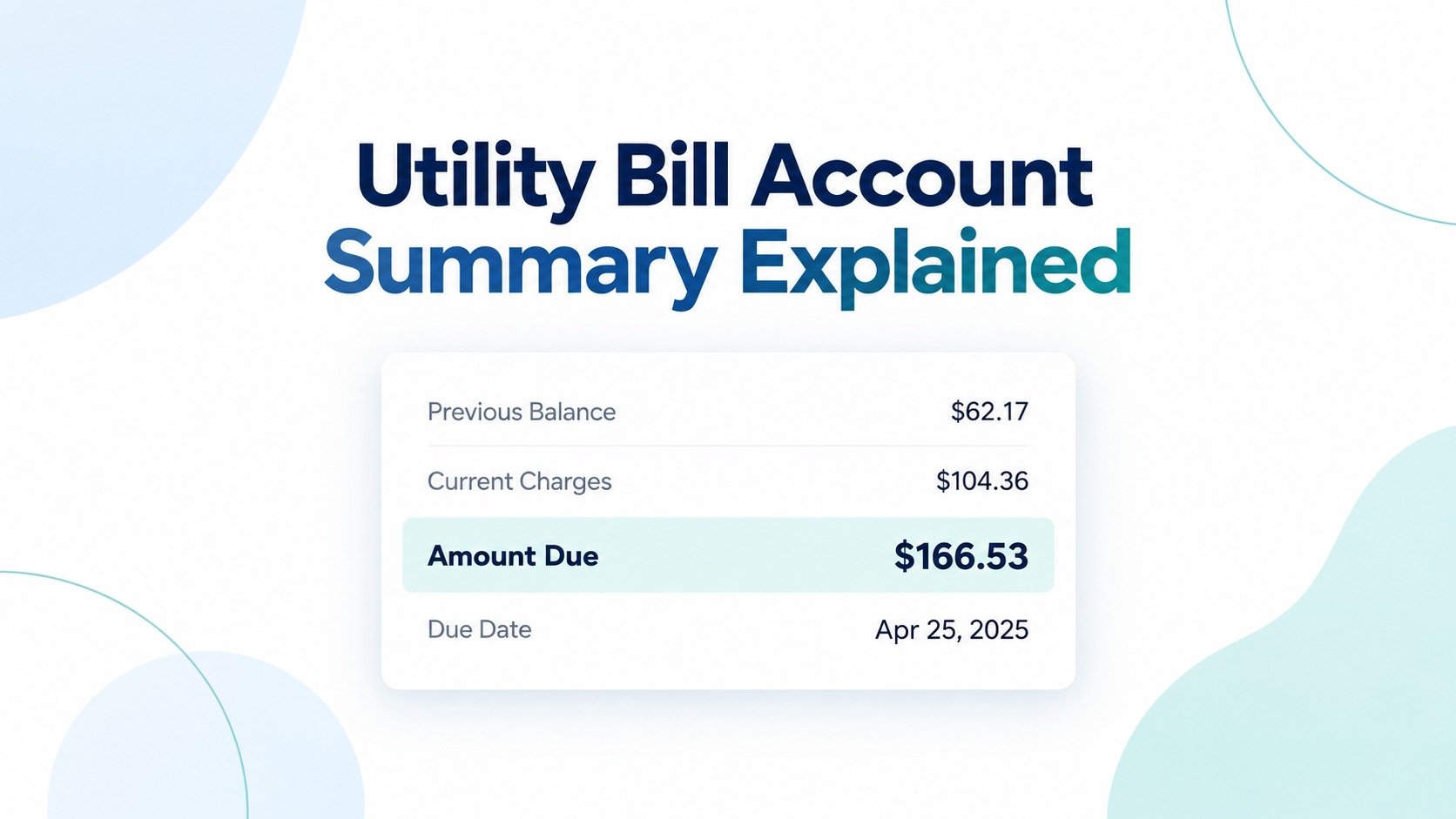
A utility bill account summary shows the account's recent financial activity and the main dates attached to the statement.
It commonly includes the previous balance, payments, credits, adjustments, balance forward, current charges, total amount due, billing date, due date, service period and account number.
A previous balance does not automatically mean that amount is still unpaid. Payments and credits can reduce it before any remaining amount is carried forward.
Current charges also do not always equal the amount due. Prior balances, account credits, Budget Billing, payment arrangements or other account programs can change the payable amount.
What Do I Owe and When Do I Pay?
These are usually the most important account-summary fields to review first.
=
Balance Forward
Balance Forward + Current Charges
=
Total Account Balance
The amount a customer is required to pay can differ from the total account balance under Budget Billing, equal-payment programs, payment arrangements or similar provider-specific programs.
UtilityBillGenerator.net creates fictional sample utility bills only.
Samples are not issued, approved, authorized, certified or verified by actual electricity, gas, water, internet, mobile or other utility providers.
Sample bills are intended for legitimate uses such as software testing, OCR development, UI/UX design, training, demonstrations and education. They should not be represented as official utility records, proof of address, proof of identity, proof of account ownership, proof of service or proof of payment.
Utility Bill Account Summary Calculator
Use this educational calculator to see how a previous balance, payments, credits, debit adjustments and current charges can affect an account balance.
This tool demonstrates ordinary account-reconciliation math. A real utility can use Budget Billing, payment arrangements, deposits, late fees, installment balances, assistance credits or other account-specific rules.
The calculator does not validate an official bill or confirm the amount actually payable to a utility provider.
If you are learning utility bills from the beginning, start with What Is a Utility Bill? and What Does a Utility Bill Look Like?.
For billing terminology, see Utility Bill Terms & Abbreviations.
To understand how current charges are produced, read How Are Utility Bills Calculated?. For measured consumption, see Utility Meter Readings Explained.
What Is a Utility Bill Account Summary?
The account summary is the section of a utility statement that summarizes recent account activity and the amount associated with the current billing cycle.
It generally helps answer:
- What was the previous account balance?
- Was a payment received?
- Were credits or adjustments applied?
- Is any amount being carried forward?
- What are the newest charges?
- What is the total account balance?
- How much is currently payable?
- When is the payment due?
Providers may use terms such as previous balance, prior balance, balance forward, outstanding balance, account balance or remaining balance. Always interpret the term in the context of that provider's statement.
Fictional Utility Bill Account Summary Example
| Previous Balance | $96.40 |
| Payment Received | −$96.40 |
| Credits / Adjustments | $0.00 |
| Balance Forward | $0.00 |
| Current Charges | $112.85 |
| Total Amount Due | $112.85 |
Crestline Power, SAMPLE-3318, STM-2026-0306 and every date, amount and account detail shown above are fictional and are not connected to a real utility provider.
What Does Previous Balance Mean on a Utility Bill?
You can see these fields together in our annotated sample utility bill, including previous balance, payments, current charges, billing dates and the final amount due.
Previous balance generally refers to the amount associated with the account before the newest billing cycle is added.
It does not automatically mean that the entire amount is still owed.
Payment received: −$96.40
Balance remaining: $0.00
That is why the previous-balance field should be read together with payments, credits, adjustments and balance forward.
Previous Balance vs Balance Forward
| Field | General Meaning |
|---|---|
| Previous balance | Amount associated with the prior statement or billing cycle. |
| Payments | Money applied to the account after the previous statement. |
| Credits | Amounts that reduce the account balance. |
| Debit adjustments | Additional amounts added to the account. |
| Balance forward | Amount remaining after applicable prior account activity. |
=
Balance Forward
Payments Received and Payment Posted Date
A utility bill can show both the amount of the most recent payment and the date that payment was received or posted.
Payment Posted: March 2, 2026
The payment date matters because a statement can be generated before or after that payment is processed.
What Do Credits and Adjustments Mean?
Credits and adjustments change an account balance outside ordinary current-period charges.
Money paid toward the account through an accepted payment method.
An amount that reduces the account without representing a new customer payment.
An additional amount added to the account because of a correction or other account activity.
Provider-specific examples may include:
- billing corrections;
- refunds;
- fee reversals;
- leak adjustments;
- transferred balances;
- deposit adjustments;
- other account corrections.
The word “adjustment” does not automatically mean a credit. An adjustment can increase or decrease the account balance.
What Are Current Charges?
Current charges are the new charges associated with the latest billing period.
Depending on the service, they can include:
- usage charges;
- customer or base charges;
- delivery or distribution charges;
- taxes;
- fees;
- service-plan charges;
- other current-period items.
To understand how these charges are calculated, read How Are Utility Bills Calculated?
Current Charges vs Total Amount Due
Current charges are only one part of the final balance. To understand how usage, rates, fixed charges, taxes and other components produce the new billing amount, see how utility bills are calculated.
Current charges and amount due are not always the same thing.
=
Total Account Balance
Fictional example
Current charges: $112.85
Total account balance: $137.85
In a standard account scenario, that total can also be the amount due.
However, Budget Billing, installment arrangements, payment plans or other programs can cause the scheduled payment to differ from the current account balance.
Current Due Date vs Past-Due Deadline
One of the easiest account-summary mistakes is assuming that the newest due date automatically applies to every dollar shown on the statement.
It may not.
| Item | Fictional Example | Meaning |
|---|---|---|
| Past-due balance | $25.00 | Older unpaid amount. |
| Past-due deadline | March 10 | Provider-specific deadline that may apply to the older balance. |
| Current charges | $112.85 | Newest billing-cycle charges. |
| Current due date | March 24 | Payment deadline associated with the current statement. |
A new bill's due date does not necessarily extend the deadline for an older past-due amount. Past-due rules, late fees and service-disconnection procedures vary by provider and jurisdiction.
Amount due after the due date
Some providers also display an amount that applies if payment is made after the regular due date.
That amount can include a late fee, penalty or other provider-specific charge.
Why Does My Utility Bill Still Show a Balance I Already Paid?
A utility statement is usually a snapshot of the account at the time the statement was generated.
If a payment is posted after that statement is created, the existing PDF, paper bill or archived statement may continue to show the older balance.
Customer payment posted: March 8
March 6 statement: May still show the pre-payment balance
Current online account: May show the March 8 payment
An older statement and a live online account can legitimately display different balances when account activity occurred after the statement was generated.
What Does a Credit Balance or “CR” Mean?
If your statement uses abbreviations such as CR or unfamiliar billing labels, review our utility bill terms and abbreviations guide for definitions of common account and charge terminology.
If payments and credits exceed the amount previously owed, the account can have a credit balance.
Payment: −$125
Account credit: $25
If current charges are $90:
Account credit: −$25
Amount due: $65
Some providers use CR or another notation to identify a credit balance.
Why Can Current Charges Differ From the Amount Due?
One reason is Budget Billing or another equal-payment program.
These programs can smooth payments over time instead of requiring the exact current-period utility cost to be paid every month.
| Field | Fictional Example |
|---|---|
| Actual current charges | $146.20 |
| Budget Billing scheduled payment | $120.00 |
| Difference carried within program | $26.20 |
Actual utility charges can differ from the scheduled Budget Billing payment. Providers use different methods to reconcile the difference.
How Payment Arrangements Affect Amount Due
A payment arrangement can divide an older balance into scheduled installments.
A statement may therefore contain:
- new current charges;
- a payment-plan installment;
- a remaining deferred balance;
- different payment deadlines.
Payment-plan installment: $40
Scheduled payment: $135
Billing Date vs Due Date
| Field | Fictional Example | Meaning |
|---|---|---|
| Billing date | March 6, 2026 | Date the statement was generated or issued. |
| Due date | March 24, 2026 | Deadline associated with the applicable payment. |
The billing date is not necessarily the first or last day of the service period, the meter-reading date or the payment due date.
What Is the Service or Billing Period?
The service period identifies the dates associated with the service covered by the statement.
Depending on the provider, the terms service period and billing period may be used similarly, but exact definitions can vary.
Service Period vs Meter Read Period
A meter-read period can differ slightly from the billing period shown in the account summary. For an electricity-specific example of how meter readings and usage appear on a statement, see our electricity bill reading guide.
A meter-read period refers specifically to the interval between meter readings used to determine consumption.
| Field | Fictional Example | Purpose |
|---|---|---|
| Service period | Feb 1 – Feb 28 | Period associated with service and billing. |
| Meter read period | Jan 31 – Feb 28 | Period between recorded meter readings. |
They can overlap closely without being identical.
For meter-reading details, see Utility Meter Readings Explained.
Why Do Billing Days Matter?
Billing days represent the number of days covered by the applicable period.
=
27.16 kWh/day
A bill covering 33 days can naturally contain more total consumption than one covering 28 days even when average daily usage remains unchanged.
What Is a Utility Bill Account Number?
An account number identifies the customer or service account within the provider's billing system.
It can connect the provider's records for:
- billing history;
- payments;
- service location;
- meter information;
- account activity;
- customer-service requests.
Real account numbers can be sensitive information. Avoid publishing or sharing them unnecessarily.
Account Number vs Meter Number vs Bill Number
| Identifier | What It Generally Identifies |
|---|---|
| Account number | The billing or service account. |
| Customer ID | The customer within the provider's account system, where used. |
| Meter number | A physical meter or metering device. |
| Bill / statement number | A specific statement or billing document. |
| Service address | The location receiving the utility service. |
A single account may be associated with multiple meters, while every billing cycle may generate a different statement or bill number.
Service Address vs Mailing Address
The service address identifies the property or location where utility service is provided.
The mailing address identifies where statements or account correspondence should be sent.
The two addresses can match, but they do not have to.
An address shown on a UtilityBillGenerator.net sample is fictional sample information and is not proof of residency, identity, account ownership or utility service.
Other Account Fields You May See
Provider-specific bills can contain additional identifiers or account information.
| Field | Possible Purpose |
|---|---|
| Billing cycle | Internal or customer-facing billing-cycle identifier. |
| Route number | Meter-reading or service-route information. |
| PIN | Account authentication or self-service access where used. |
| Payment reference | Payment-processing identifier. |
| AutoPay status | Indicates automatic-payment enrollment where applicable. |
How Account Summary Fields Work in a Sample Utility Bill
If you need to build a fictional statement for a mockup, classroom, testing or training workflow, you can create a custom utility bill sample using the main tool.
A fictional sample utility bill can include account-summary fields to demonstrate how utility-style documents are structured.
| Sample Field | Fictional Example |
|---|---|
| Sample account number | SAMPLE-3318 |
| Statement number | STM-2026-0306 |
| Billing date | March 6, 2026 |
| Service period | Feb 1 – Feb 28, 2026 |
| Previous balance | $96.40 |
| Last payment | −$96.40 |
| Payment posted | March 2, 2026 |
| Balance forward | $0.00 |
| Current charges | $112.85 |
| Amount due | $112.85 |
Fictional sample account data can be useful for:
- software testing;
- OCR development;
- document extraction;
- UI/UX prototypes;
- training;
- educational exercises;
- product demonstrations.
UtilityBillGenerator.net does not create real utility accounts, authenticate customers, confirm balances or verify utility service.
12-Step Utility Bill Account Summary Checklist
To compare how account-summary information appears across different services, review our sample electricity bill, sample gas bill, and sample internet and phone bill examples.
- Confirm the account number. Make sure you are reviewing the intended account.
- Check the statement number if shown. Confirm which billing document you are viewing.
- Check the service address. Verify the location associated with the account.
- Check the service period. Identify the dates associated with the bill.
- Check the billing date. Determine when the statement was generated.
- Review the previous balance. Do not assume the entire amount remains unpaid.
- Review the last payment and payment date. Check whether a payment was posted before or after the statement date.
- Review credits and adjustments. Determine whether they increase or decrease the balance.
- Find the balance forward. Identify what remains after prior account activity.
- Review current charges. These represent the newest billing-period charges.
- Look for past-due amounts separately. An older balance can have a different deadline.
- Confirm the payable amount and applicable due date. Budget Billing or payment arrangements can change what is currently required.
Frequently Asked Questions
It is the section that summarizes recent financial activity and important billing dates, including previous balance, payments, credits, balance forward, current charges and the applicable amount due.
Not necessarily. Payments, credits or adjustments may have been applied after the previous statement. Review the balance-forward field to see what remains.
Balance forward generally represents the remaining prior balance after applicable payments, credits and adjustments have been applied.
Previous balances, credits, Budget Billing, payment arrangements or other account programs can make the scheduled amount due different from the newest current charges.
The statement may have been generated before the payment was posted. An archived statement can continue to show the older account snapshot even if the live online balance has changed.
Not necessarily. A provider can apply a different deadline to an older past-due amount. Check the issuing utility's payment and delinquency rules.
Some providers use CR to indicate a credit balance, but notation varies. Check the bill legend or provider documentation before interpreting it.
The billing date generally indicates when the statement was generated or issued. The due date identifies the applicable payment deadline.
No. The account number identifies the billing or service account, while the meter number identifies a physical meter or metering device.
An account number generally identifies the ongoing customer or service account. A bill or statement number can identify one specific billing document.
No. UtilityBillGenerator.net creates fictional sample utility bills only. Account numbers, balances, dates, addresses and other fields in generated samples are fictional sample data and are not verified by a real utility provider.
Create a Sample Utility Bill
UtilityBillGenerator.net lets you create customizable sample utility bills using fictional information for legitimate software testing, OCR development, UI/UX mockups, training, demonstrations and educational projects.
Sample bills are not issued, authorized, certified or verified by real utility providers and are not official utility-provider records.
Create a Sample Utility BillOfficial Sources & Methodology
Utility providers use different terminology and statement layouts. This guide therefore focuses on account-summary concepts that appear across multiple current utility and municipal bill guides.
- WSSC Water — Improved Bill Layout
- City of Robinson — How to Read Your Utility Bill
- Sacramento County — Utility Billing
- Brookings Municipal Utilities — How to Read My Bill
- PG&E — Budget Billing Program
- Idaho Power — Bill Glossary
- City of Morgan Hill — How to Read a Utility Bill
All Crestline Power names, account identifiers, statement identifiers, dates, balances and amounts shown on this page are fictional educational examples.