
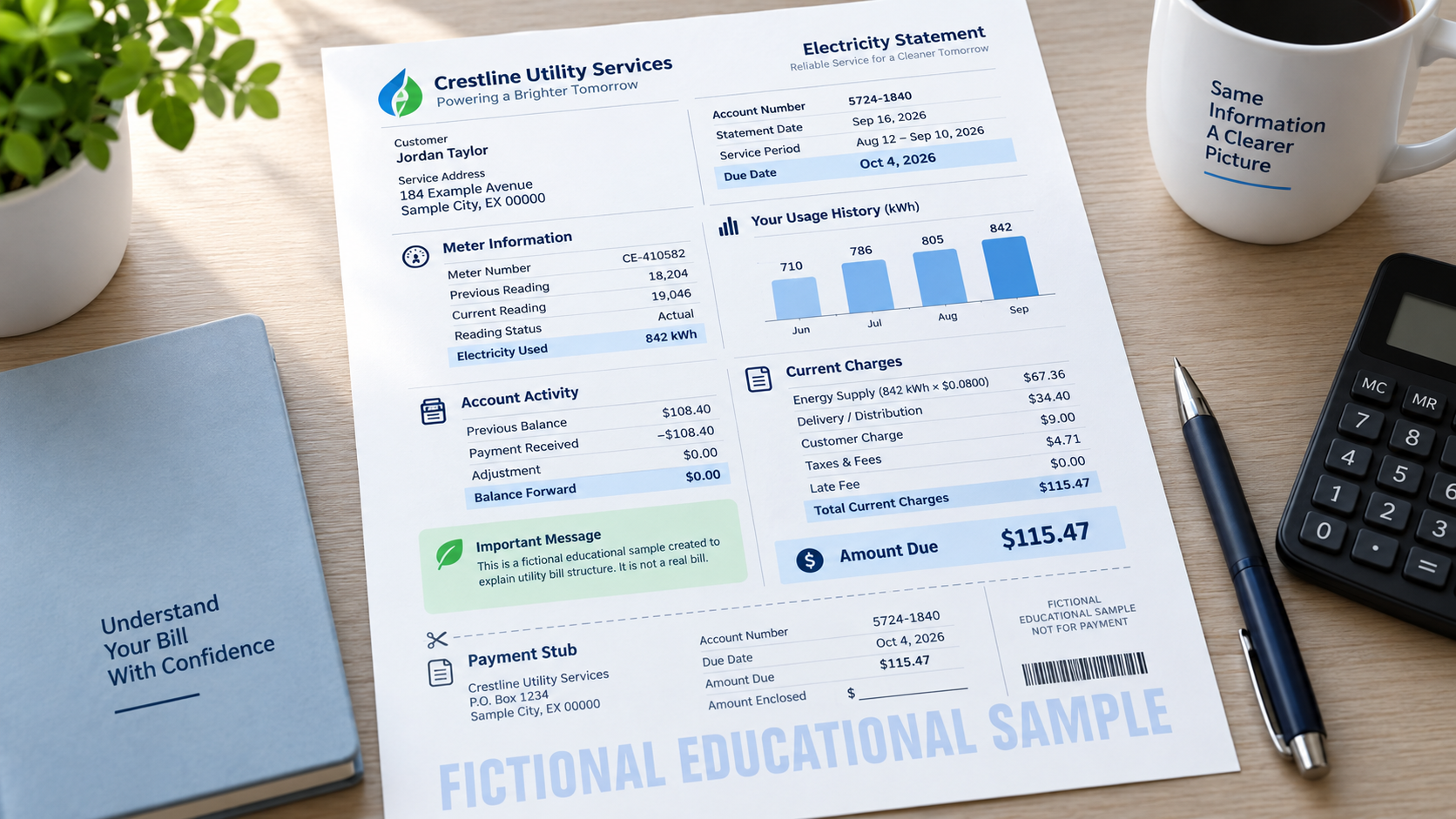
A sample utility bill becomes much easier to understand when the actual statement, meter readings, account activity and charge calculations are shown together.
The fictional example below includes customer details, service address, account number, meter number, previous and current readings, usage, rate calculation, previous balance, payments, adjustments, fixed charges, taxes, late-fee information, current charges, amount due and a payment stub.
Use it to learn how a utility statement is structured and how the numbers connect. It is an educational example only, not a substitute for a real provider-issued bill.
Complete Annotated Sample Utility Bill
This fictional example uses an electricity statement because electricity bills can show both metered usage and several distinct charge categories.
Select a numbered marker to see what that field means.
Crestline Utility Services
NOT PROOF OF ADDRESS
Sample City, EX 00000
Payment Stub - Educational Example
Every Major Utility Bill Section Explained
If you are new to this type of document, start with what a utility bill is and which household services are commonly included before reviewing the individual sections below.
Customer Name
Identifies the customer or account holder associated with the real provider account.
Service Address vs Billing Address
Service Address
The location where electricity, gas, water or another service is delivered.
Billing Address
The address used to send correspondence or statements. It can be different from the service location.
Account Number
Connects billing activity to the provider's customer-account system. It is different from a meter number.
Statement Date
The date the current bill was produced.
Service Period
The period associated with the current service or usage.
Due Date
The payment deadline for the amount currently owed.
Meter Information
Metered services can show the meter identifier, previous reading, current reading and reading status.
Previous Account Activity
This area can show the previous balance, payments, credits and adjustments before the current cycle's new charges are added.
Current Charges
These are new charges created for the current billing cycle.
Amount Due
The amount due combines any remaining previous account balance with the current billing-cycle charges.
How Meter Readings and Usage Work in This Sample
The fictional statement shows:
| Meter Field | Value |
|---|---|
| Meter number | CE-410582 |
| Previous reading | 18,204 |
| Current reading | 19,046 |
| Reading status | Actual |
| Usage | 842 kWh |
The usage quantity is then used in the fictional supply-charge calculation:
Monthly Usage History
Many real electricity, gas and water bills include historical usage so customers can compare the current period with previous months.
Usage history can help answer an important question:
How the Amount Due Is Calculated
For the broader billing formula and additional worked examples, see how utility bills are calculated. If you want more detail on previous balances, payments, credits, billing periods and the final amount due, see our utility bill account summary guide.
Current Fictional Sample
| Account Activity | Amount |
|---|---|
| Previous balance | $108.40 |
| Payment received | −$108.40 |
| Adjustment | $0.00 |
| Remaining prior balance | $0.00 |
| Current charges | $115.47 |
| Amount due | $115.47 |
If the Old Balance Were Not Fully Paid
Suppose only $80 of the $108.40 previous balance had been paid.
Adjustments, Late Fees & Special Messages
What Is an Adjustment?
An adjustment can increase or reduce the account because of a billing correction or other account activity.
Possible examples include:
- corrected meter reading
- corrected usage
- billing correction
- account credit
- prior-period correction
What Is a Late Fee?
A late fee is separate from normal utility usage. If one applies, it can increase the amount due without changing the current month's consumption.
The fictional sample shows: $0.00 late fee.
What Is the Message Area For?
Real providers can use a notice or message area for:
- rate-change notices
- payment reminders
- service information
- conservation information
- program updates
- contact or mailing changes
Why Is This Utility Bill Higher Than Last Month?
A bill can increase because of usage, rate, fixed charges, fees or previous account activity.
Usage vs Rate Change Checker
This simplified calculator helps identify whether usage or pricing was the larger driver.
What Changes by Utility Bill Type?
| Service | Typical Key Fields | Common Usage / Billing Unit |
|---|---|---|
| Electricity | Meter, kWh, supply, delivery, customer charge | kWh |
| Gas | Meter, CCF/therms, conversion factor, supply, delivery | CCF / therms |
| Water | Meter, previous/current reading, water use, sewer | Gallons / CCF |
| Internet / Wi-Fi | Plan, equipment, discounts, add-ons, one-time fees | Usually plan-based |
| Mobile Phone | Lines, device payments, promotional credits, data, roaming | Plan / data / lines |
For service-specific billing education, see:
How Real Utility Bills Differ
Provider designs vary, but the main billing fields usually follow a recognizable structure. See what a utility bill looks like for a broader explanation of common bill layouts and sections.
Real bill formats vary considerably by provider and service type. That is why a provider-neutral sample should explain the common billing concepts without pretending every company uses the same layout.
Municipal Utility Example
The City of Minneapolis sample-bill guidance includes fields such as meter number, previous and current readings, reading codes, usage, previous balance, payments, adjustments, current charges and payment stub.
View Minneapolis sample-bill guidanceWastewater Utility Example
Clark Regional Wastewater District's sample statement includes service period, account activity, adjustments, finance-related lines, amount due and a payment stub.
View Clark Regional sample PDFTemplate-Style Example
Jotform's utility template demonstrates account details, statement dates, meter/usage fields, cost calculations, taxes and total amounts.
View Jotform utility templateReal Utility Bill vs Fictional Sample Utility Bill
For software QA, document extraction and recognition workflows, our utility bill OCR testing guide explains ground truth, field validation and structured test cases using fictional sample documents.
| Real Utility Bill | Fictional Sample |
|---|---|
| Issued by a real provider | Created as an educational example |
| Connected to a real customer account | Not connected to utility service |
| Contains actual billing history | Contains fictional or user-entered data |
| Connected to a real meter or plan where applicable | No verifiable meter or service relationship |
| Can establish real service history | Cannot establish service history |
| May be accepted by an organization for certain administrative uses | Not proof of address, identity or service |
What Makes a Genuine Utility Bill Verifiable?
A genuine statement is connected to:
- the provider's real billing system
- an actual customer account
- a real service relationship
- real billing history
- an actual service location
- the provider's authentic issue date and statement records
Utility Bill Checking Tools
Bill Reconciliation Checker
Enter the major billing values to see whether the amount due reconciles.
What Utility Bill Section Am I Looking At?
Identifies the customer account within the provider's billing system.
Choose the Right Sample Utility Bill Generator
For legitimate testing, training, classroom projects, software development, OCR testing and UI mockups, use the generator that matches the service type.
Sample Electricity Bill Generator
Create a fictional electricity statement with kWh usage, service dates and electric-charge fields.
Create a Sample Electricity Bill →Sample Gas Bill Generator
Create a fictional gas statement with usage, account, service and charge details.
Create a Sample Gas Bill →Sample Wi-Fi & Mobile Bill Generator
Create fictional communication-service statements with plan, equipment, line and billing details.
Create a Sample Wi-Fi or Mobile Bill →Sample Spectrum-Style Internet Bill Generator
Create a fictional internet/cable-style statement with service, equipment, discounts and taxes.
Create a Sample Internet & Cable Bill →Learn More About Utility Bills
Frequently Asked Questions About Sample Utility Bills
What information is on a sample utility bill?
A sample can demonstrate customer details, service address, account number, billing dates, meter or plan information, usage, previous balance, payments, adjustments, current charges, taxes, fees and amount due.
What is the difference between a meter number and account number?
The account number identifies the customer billing account. The meter number identifies a particular meter associated with a metered service location.
How is electricity usage calculated from meter readings?
A simplified electricity example subtracts the previous reading from the current reading. In this fictional sample, 19,046 − 18,204 equals 842 kWh.
Why is the amount due different from current charges?
Previous balances, payments, credits, adjustments or late fees can make the final amount due different from the new billing-cycle charges.
What is an adjustment on a utility bill?
An adjustment can be a billing correction, account credit, usage correction or another provider-approved change to the account.
Does every utility bill have a meter reading?
No. Electricity, gas and water commonly use meters. Internet, Wi-Fi and mobile services usually use plans, lines, equipment or data information instead.
What is a payment stub?
A payment stub or coupon is a detachable or printable section of some paper bills that repeats payment information such as account number, due date and amount due.
Can I print the sample utility bill on this page?
Yes. The educational print option preserves the fictional-sample marking so the document remains clearly identified as an educational example.
Can a fictional sample utility bill be used as proof of address?
No. A fictional sample is not issued or verified by a real utility provider and cannot verify residence, identity, account ownership or service.
How do I get a real utility bill?
Sign in to your actual provider's account portal or contact the provider and request a genuine copy of your statement.
Can I create a fictional electricity bill sample?
For legitimate testing, education and demonstration, use the sample electricity bill generator .
Can I create a fictional gas bill sample?
For legitimate sample-document use, see the sample gas bill generator .
Can I create a fictional Wi-Fi or mobile statement?
Use the sample Wi-Fi and mobile bill generator for legitimate testing, training and demonstration projects.
Create a Sample Utility Bill
Need a fictional utility statement for software testing, OCR testing, training, classroom work or a UI/UX mockup?
Choose a service type and create a clearly fictional sample. Generated documents are not official utility records and cannot be used as proof of address, identity, account ownership, service or payment.
create a sample utility bill online