
Home › Utility Bill Learning Center › How to Read an Electricity Bill
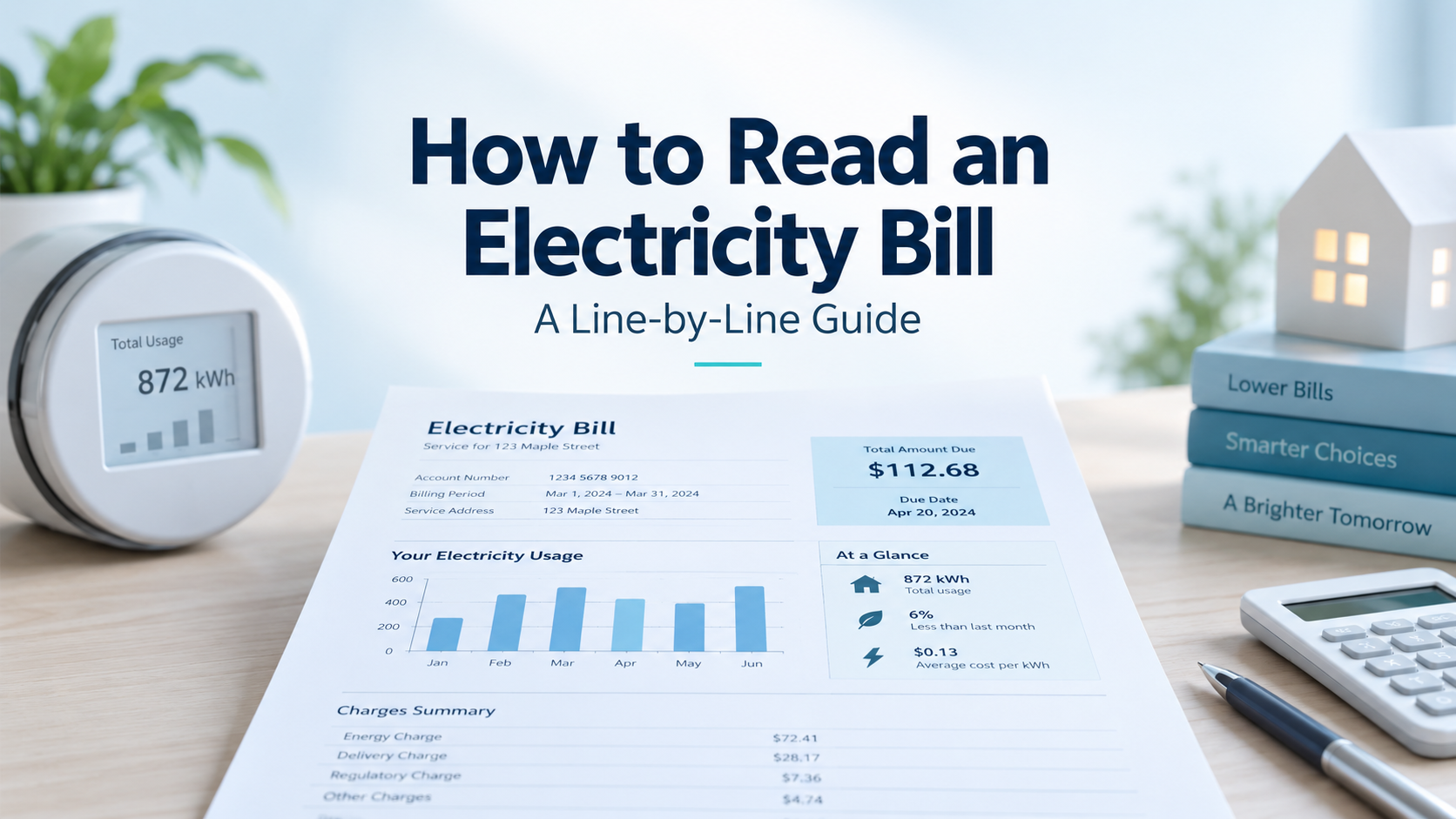
To read an electricity bill, follow this order: billing period → kWh usage → meter-read status → rate plan → itemized charges → amount due.
First confirm the dates and billing days. Then find total electricity usage in kilowatt-hours, check whether the meter reading is actual or estimated, identify the applicable rate plan, and separate energy or supply charges from delivery, fixed charges, taxes, fees and credits.
When comparing bills, use both total kWh and average daily usage. If you want a broader cost comparison, divide current electricity charges by billed kWh to estimate the effective bill-wide cost per kWh.
Find These 8 Things First on Your Electricity Bill
If you are comparing these sections with a fictional statement for testing, education or a design mockup, our utility bill sample maker provides a broader starting point across supported utility formats.
UtilityBillGenerator.net creates fictional sample utility bills only.
Samples are not issued, approved, authorized, certified or verified by actual electricity providers. They are intended for legitimate software testing, OCR development, UI/UX design, demonstrations, training and educational projects.
Annotated Sample Electricity Bill
For a complete visual example showing these fields together, see our annotated sample electricity bill. It provides a useful reference for account details, meter usage, charges and the final amount due.
The fictional example below shows how major electricity-bill sections can fit together. It also gives us one consistent example to use throughout this guide.
| Energy Rate | $0.080/kWh |
| Energy Usage Charge | $67.36 |
| Delivery / Distribution | $34.40 |
| Customer Charge | $9.00 |
| Taxes / Fees | $4.71 |
| Total Current Electricity Charges | $115.47 |
Start with fields 3 through 6 to understand the period and pricing. Then check fields 7 through 10 to understand how electricity consumption was measured. Finally, read the itemized charges to see how the dollar total was built.
Crestline Power, SAMPLE-3318, MTR-604821, the rate plan, readings, dates and dollar values above are fictional and are not connected to an actual electricity provider.
Electricity Bill Math Checker
This educational checker compares meter-derived usage with reported kWh, tests a simplified flat-rate energy calculation, adds visible current electricity charges, calculates average daily usage and estimates the effective bill-wide cost per kWh.
The energy-rate portion assumes one entered rate multiplied by reported kWh. Tiered and time-of-use bills require separate calculations for each tier or time period.
Reported usage: ✓ matches the meter-derived result.
Average daily usage: 30.07 kWh/day.
Flat-rate energy charge: ✓ reported charge matches reported kWh × entered rate within normal rounding tolerance.
Meter-derived energy cost at the entered rate: $67.36.
Visible current-charge total: ✓ visible components match the reported current-electricity total within normal rounding tolerance.
This checker compares arithmetic only. It does not authenticate or certify an electricity statement.
It does not authenticate a bill, determine whether a rate is legally correct, interpret every tariff, confirm a meter record or verify provider-issued account information.
For overall utility-bill anatomy, read What Does a Utility Bill Look Like?
For previous balances, payments, credits and amount due, read Utility Bill Account Summary Explained .
1. Start With the Account Information
The first section of an electricity bill usually identifies the account, service location and billing record.
| Field | What It Generally Identifies |
|---|---|
| Account number | The customer or service billing account. |
| Meter number | The physical meter or meter record associated with the service. |
| Statement number | A specific billing statement, where the provider uses one. |
| Service address | The location receiving electricity service. |
| Rate schedule / service class | The pricing category or tariff applied to the account. |
2. Check the Billing or Service Period
The service or billing period identifies the dates associated with the electricity charges on the statement.
with provider-specific date-count rules
A service period and a meter-read period can be very similar without always being identical. For example, fixed service charges may follow the billing period while consumption is tied to recorded meter-read dates.
3. Find the Amount Due and Due Date
To understand how previous balances, payments, credits, current charges and the amount due work together, see our utility bill account summary guide.
The amount due is not always the same as current electricity charges.
The account total can also reflect:
- previous balances;
- payments;
- credits;
- Budget Billing;
- payment arrangements;
- other account activity.
For the full reconciliation process, see Utility Bill Account Summary Explained .
4. Read the Previous and Current Meter Readings
Confirm the meter number first, then find the previous and current readings associated with the billing period.
Current reading: 19,046
Electricity meters normally record cumulative use. The difference between readings is therefore more important than the current reading by itself.
5. Check Whether the Reading Is Actual or Estimated
| Reading Type | General Meaning |
|---|---|
| Actual | Based on meter data rather than a calculated estimate. |
| Estimated | Calculated when final usable meter data was not used. |
| Remote / smart | Meter information collected electronically. |
Estimated reading correction example
Later actual reading: 19,046
Difference: 146 meter units
The provider can later reconcile an earlier estimate when actual meter data becomes available. The precise correction method depends on the utility and tariff.
For detailed meter-reading guidance, see Utility Meter Readings Explained.
6. What Does kWh Mean on an Electricity Bill?
kWh means kilowatt-hour. It measures electrical energy consumed over time.
=
Energy in kWh
Simple appliance example
=
6 kWh
The U.S. Energy Information Administration explains electricity measurement in watts, kilowatts and kilowatt-hours in its electricity measurement guidance .
7. Calculate Electricity Usage From Meter Readings
=
842 kWh
Example with a meter multiplier
Previous reading: 8,000
Difference: 120
Multiplier: 10
120 × 10 = 1,200 kWh
Do not automatically calculate zero usage. Check for meter rollover, meter replacement, reset, another register, the wrong meter or a data-entry error.
8. kW vs kWh: What Is the Difference?
| Unit | Meaning | Simple Way to Think About It |
|---|---|---|
| kW | Rate of electricity use at a moment in time. | How fast electricity is being used. |
| kWh | Electrical energy accumulated over time. | How much electricity was used. |
9. Identify the Electricity Rate Plan or Tariff
Knowing total kWh is not enough to know what the electricity should cost. You also need the applicable pricing structure.
The applicable consumption is priced at one unit rate.
Different blocks of usage can have different rates.
Rates vary depending on when electricity is consumed.
Rates can change between seasons.
Some non-residential accounts include maximum-demand charges.
The scheduled payment may differ from actual current-period charges.
Where can I find the rate-plan name?
Depending on the provider, the rate plan may appear near the service details, rate code, tariff, service class or pricing-plan section of the statement or online account.
For a real account, confirm the current rate using the electricity provider's official tariff or rate-plan information rather than relying on a generic internet rate.
The U.S. Department of Energy provides additional guidance on evaluating utility rate options .
10. Understand the Electricity Supply or Generation Charge
The supply or generation portion generally relates to the electricity commodity or the cost associated with obtaining electrical energy.
=
$67.36
Depending on the market and jurisdiction, electricity supply may come from the utility itself or from a competitive electricity supplier.
11. Understand Transmission, Distribution and Delivery
For a deeper breakdown of generation, supply, transmission, distribution, delivery, customer charges and riders, see electricity bill charges explained.
| Charge Type | General Meaning |
|---|---|
| Supply / generation | Electricity commodity or generation-related cost. |
| Transmission | Moving electricity across higher-voltage networks. |
| Distribution | Local network used to deliver electricity to customers. |
| Delivery | A broader provider label that can include distribution and other delivery-related costs. |
Some providers show transmission and distribution separately. Others combine multiple network costs under a broader delivery category.
Con Edison, for example, separates supply and delivery when explaining its electricity-bill structure in its bill-reading guidance .
12. Common Electricity Bill Charge Labels
Electric bills often use provider-specific abbreviations and charge labels. Our utility bill terms and abbreviations glossary can help decode unfamiliar terminology.
| Label You May See | Usually Refers To |
|---|---|
| Generation | Producing or procuring electricity. |
| Supply | Electricity commodity or supplier-related cost. |
| Transmission | Higher-voltage transportation of electricity. |
| Distribution | Local network delivery. |
| Delivery | Provider-specific network or infrastructure charges. |
| Customer Charge | Recurring account or basic-service charge. |
| Fuel Adjustment | A provider-specific adjustment associated with fuel or generation costs. |
| Generation Adjustment | A provider-specific rate adjustment linked to electricity supply or generation. |
| System Benefit Charge | A jurisdiction-specific charge supporting designated energy programs. |
| Rider | A provider- or regulator-specific tariff adjustment. |
| Minimum Charge | A minimum amount that can apply even at very low electricity consumption. |
13. Look for the Customer or Fixed Charge
Many electricity bills include a recurring charge that does not depend directly on each additional kWh consumed.
Why can a very low-use bill still cost money?
Customer charge: $9.00
Taxes / other applicable charges: $1.20
Total: $10.20
This is why zero or very low electricity consumption does not always produce a zero-dollar statement.
14. Review Taxes, Fees, Riders and Credits
| Can Increase the Bill | Can Reduce the Bill |
|---|---|
| Taxes | Account credits |
| Regulatory charges | Promotional credits |
| Franchise fees | Energy-assistance credits |
| Fuel adjustments | Billing corrections |
| Rate riders | Solar / export credits where applicable |
15. Calculate the Effective Cost Per kWh
=
Effective bill-wide cost per kWh
Using the fictional example:
=
$0.1371/kWh
13.71 cents/kWh
Compare that with the energy-only rate:
Effective bill-wide cost: 13.71 cents/kWh
Exclude past-due balances, deposits, late-payment amounts, unrelated water or gas services and other non-current electricity items when calculating an effective current-electricity cost per kWh.
16. Compare Billing Days Before Comparing Bills
=
Total kWh ÷ Billing days
=
30.07 kWh/day
This makes comparisons more meaningful when two bills cover different numbers of days.
17. Read the Electricity Usage History Correctly
| Period | Total Usage | Billing Days | Average Daily Usage |
|---|---|---|---|
| May | 820 kWh | 30 | 27.33 kWh/day |
| June | 950 kWh | 35 | 27.14 kWh/day |
When possible, also compare the same season or the same month from the previous year. Heating and cooling needs can make a winter-to-summer comparison misleading.
18. How Tiered Electricity Rates Work
Remaining 342 kWh × $0.11 = $37.62
Total energy charge = $77.62
The blended energy-only rate in this fictional example is:
=
9.22 cents/kWh
19. How Time-of-Use Electricity Pricing Works
| Period | Fictional Usage | Fictional Rate |
|---|---|---|
| Peak | 200 kWh | $0.18/kWh |
| Off-peak | 642 kWh | $0.07/kWh |
642 × $0.07 = $44.94
Energy charge = $80.94
20. How to Read a Solar Electricity Bill
Solar billing can be confusing because the electricity shown by a solar monitoring app is not necessarily the same number shown on the utility statement.
Home-generated solar electricity can be divided into:
- solar energy used directly inside the property;
- solar energy exported to the grid.
=
Self-consumed solar + Solar exported to the grid
Total household electricity use can therefore be larger than the electricity imported from the grid.
=
Grid imports + Solar electricity used directly in the home
Fictional solar example
| Electricity Flow | Fictional Amount |
|---|---|
| Total solar production | 800 kWh |
| Exported to grid | 378 kWh |
| Self-consumed solar | 422 kWh |
| Electricity imported from grid | 906 kWh |
+
422 kWh self-consumed solar
=
1,328 kWh total home electricity use
This is one reason a solar monitoring app can show different energy numbers than the electricity bill.
21. Why Is My Electricity Bill Higher?
Start with one question: Did your kWh consumption increase?
- Compare average daily usage.
- Check heating and cooling demand.
- Look for new appliances or loads.
- Review seasonal changes.
- Check whether the billing period was longer.
- Look for an estimated-to-actual correction.
- Check whether the electricity rate changed.
- Check tier or time-of-use pricing.
- Review delivery charges.
- Review fixed charges.
- Check taxes and riders.
- Look for expired credits or discounts.
- Check whether an older balance was added.
This distinction helps separate a usage problem from a pricing or account-summary change.
22. What to Do If Your Electricity Bill Does Not Add Up
If the numbers still do not reconcile, compare the statement with our utility bill calculation guide to understand how usage, rates, fixed charges, taxes and adjustments combine into the final total.
- Save the statement. Keep the PDF, paper bill or account screenshot you are reviewing.
- Confirm the billing period. Make sure you are reviewing the correct statement.
- Confirm the meter number. Make sure the reading belongs to the relevant meter.
- Check previous and current readings. Look for rollover, replacement or incorrect entry.
- Check the reading status. Determine whether it is actual or estimated.
- Identify the disputed line. For example, usage, rate, delivery charge or prior balance.
- Find the rate plan or tariff. Save the provider's current tariff or pricing information used for your review.
- Recalculate visible arithmetic. Use the math checker above as a basic cross-check.
- Contact the electricity provider. Ask how the disputed amount was calculated.
- Ask which tariff provision applies. A rate code or tariff can explain a charge that is not obvious on the statement.
- Keep the case or reference number. Document the provider's explanation.
- Use the applicable regulator or consumer complaint process if necessary. Complaint procedures differ by jurisdiction.
The site creates fictional sample utility bills only. It does not authenticate real electricity statements, meter records, tariffs or account balances.
23. Residential vs Commercial Electricity Bills
| Residential Bill | Commercial / Industrial Bill May Also Include |
|---|---|
| kWh consumption | kWh consumption |
| Energy rates | Maximum demand in kW |
| Delivery charges | Demand charges |
| Fixed charges | Power factor |
| Taxes and fees | Demand ratchets or complex tariff provisions |
How Sample Electricity Bills Can Be Used
For a provider-neutral document example, compare this guide with our sample utility bill. Developers working with document extraction or field recognition can also review our utility bill OCR testing guide.
A fictional sample electricity bill can demonstrate:
- sample account information;
- service dates;
- meter readings;
- kWh consumption;
- fictional rate information;
- energy charges;
- delivery charges;
- taxes and fees;
- sample current charges.
Legitimate uses include:
- software testing;
- OCR development;
- document-extraction testing;
- UI/UX prototypes;
- training;
- educational exercises;
- product demonstrations.
Any provider name, account number, address, meter reading, rate, charge or balance shown in a UtilityBillGenerator.net sample is fictional sample information and is not verified by an actual electricity provider.
15-Step Electricity Bill Reading Checklist
- Confirm the account, meter number and service address.
- Check the billing or service period.
- Check the number of billing days.
- Find the amount due and due date.
- Locate the previous meter reading.
- Locate the current meter reading.
- Check whether the reading is actual or estimated.
- Confirm total kWh consumption.
- Identify the rate plan or tariff.
- Review the electricity supply or generation charge.
- Review transmission, distribution or delivery charges.
- Check the customer or fixed charge.
- Review taxes, fees, riders and credits.
- Compare average daily usage with earlier bills.
- Calculate effective current-electricity cost per kWh.
Frequently Asked Questions
Start with the billing period and amount due. Then review total kWh, meter readings, reading status, rate plan, supply charges, delivery charges, fixed charges, taxes, fees and credits.
kWh means kilowatt-hour. It measures electrical energy consumed over time and is a common residential electricity-billing unit.
Subtract the previous cumulative meter reading from the current reading and apply any documented meter multiplier.
An electricity provider can estimate usage when usable meter data is unavailable or not used for that billing cycle. A later actual reading can result in a correction or reconciliation.
Current electricity charges relate to the newest billing period. Amount due can also reflect prior balances, credits, Budget Billing, payment arrangements or other account activity.
kW measures the rate of electricity use at a point in time. kWh measures electrical energy accumulated over time.
The energy rate may cover only the supply portion. Delivery charges, fixed charges, taxes and other current electricity charges can increase the complete bill-wide cost per kWh.
A solar app can show total solar production, while the utility meter generally records grid imports and exports. Solar electricity consumed directly in the property may never pass through the utility meter as imported electricity.
Confirm the billing period, meter number, readings, reading status and rate plan. Recalculate visible arithmetic, then ask the electricity provider to explain the disputed charge and applicable tariff.
No. UtilityBillGenerator.net creates fictional sample utility bills only. Samples are not issued, authorized, certified or verified by real electricity providers.
Create a Sample Electricity Bill
For a broader multi-utility workflow before choosing a specific electricity template, you can create a custom utility bill online from the main site.
UtilityBillGenerator.net lets you create customizable sample electricity bills using fictional information for legitimate software testing, OCR development, UI/UX mockups, demonstrations, training and educational projects.
Samples are not issued, approved, authorized, certified or verified by actual electricity providers and are not official provider records.
Create a Sample Electricity BillOfficial Sources & Methodology
Electricity-bill terminology, meter-reading methods, tariffs and rate structures vary by provider. This guide uses provider-neutral explanations and fictional examples while cross-checking technical concepts against current government and utility guidance.
- U.S. Department of Energy - Understanding Your Electricity Bills
- U.S. Energy Information Administration - Measuring Electricity
- U.S. Department of Energy - Evaluating Your Utility Rate Options
- Con Edison - How to Read Your Bill
- DOE Better Buildings - Understanding Your Utility Bill: Electricity
All Crestline Power details, sample identifiers, meter readings, rates, dates and dollar values shown in this article are fictional educational examples.