
Home › Utility Bill Learning Center › How Are Utility Bills Calculated?
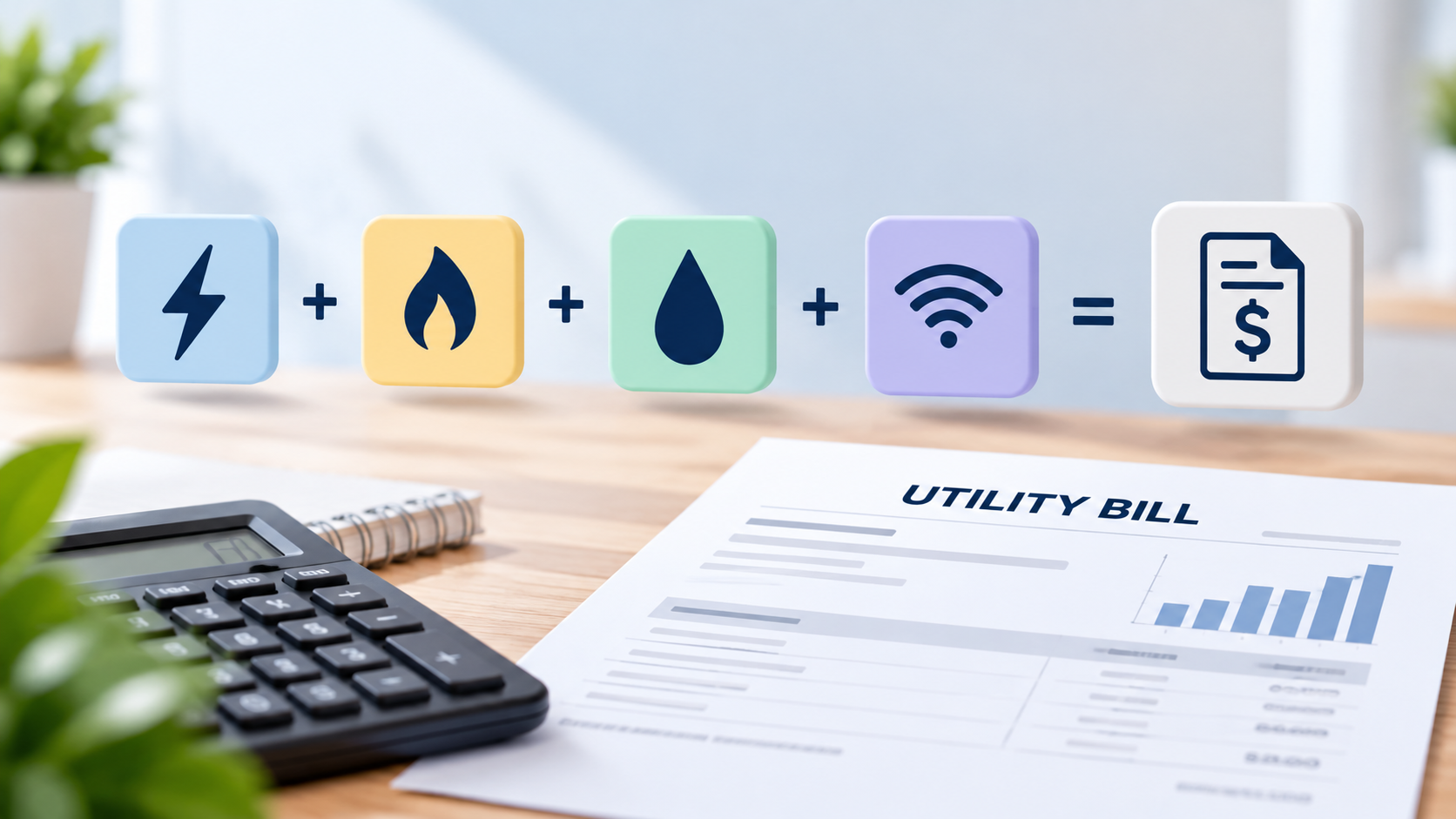
Most utility bills are calculated by measuring usage or starting with a service plan, applying the applicable rate structure, adding fixed charges, delivery or service charges, taxes and fees, then adjusting for previous balances, payments and credits.
Electricity, natural gas and water can use different measurement units and rate structures, so the exact calculation depends on the utility provider, account type and location.
+
FIXED / BASE CHARGES
+
DELIVERY / DISTRIBUTION
+
TAXES / FEES
±
BALANCE ADJUSTMENTS
=
AMOUNT DUE
This is why simply multiplying usage by one rate does not always reproduce the final amount printed on a real utility statement.
UtilityBillGenerator.net provides sample utility bills only. Sample bills created through the site are fictional documents. They are not issued, approved, authorized, certified or verified by actual electricity, gas, water, internet, mobile or other utility providers.
Sample utility bills are intended for legitimate uses such as software development, OCR testing, UI/UX design, training, demonstrations and educational projects. They should not be represented as official utility-provider records, proof of address, proof of identity, proof of account ownership, proof of service or proof of payment.
Simple Utility Bill Calculator & Bill Math Checker
Use this educational calculator to understand how common bill components can combine. Enter usage, rates and charges to estimate a total.
This calculator is a generic educational tool. It does not connect to utility providers, validate official statements or reproduce a provider's exact tariff automatically.
This calculator demonstrates common utility-bill math only. Real utility statements may include provider-specific tiers, time-of-use periods, demand charges, fuel adjustments, meter multipliers, minimum charges, riders, taxes or other tariff components.
It does not confirm whether a real utility bill is genuine, authorized or valid.
If you first need the basic definition, read What Is a Utility Bill? Types, Examples & How It Works. To understand where these charges appear on a statement, see What Does a Utility Bill Look Like? Every Section Explained.
The Basic Utility Bill Calculation Formula
If you want to compare the formula with a fictional statement while testing different usage, rates and charges, the online utility bill generator provides a practical starting point across supported utility types.
A simple usage-times-rate calculation explains only one part of many utility bills.
A more realistic provider-neutral model is:
+
fixed charges
+
supply, delivery or service charges
+
taxes and fees
±
account adjustments
+
previous unpaid balance
−
payments and credits
=
amount due
Current charges generally refer to new charges from the latest billing period. The amount due can also include an unpaid previous balance or subtract payments and credits.
Electricity, gas and water commonly begin with measured consumption.
The applicable rate determines how all or part of that consumption is priced.
Base or customer charges may apply even when usage is low.
Electricity and gas may include supply, transmission or distribution costs.
Jurisdictional and provider-specific charges can increase the bill.
Balances, payments, credits and adjustments affect the amount due.
1. Start With Usage or the Service Amount
For a metered utility, consumption is normally one of the first inputs in the calculation.
| Utility | Common Measurement | What It Measures |
|---|---|---|
| Electricity | kWh | Electrical energy consumed |
| Natural gas | Therms, CCF, Mcf or another applicable unit | Gas energy and/or volume |
| Water | Gallons, cubic feet or CCF | Water volume consumed |
| Internet/mobile | Usually plan-based | Recurring service rather than physical utility-meter consumption |
When a meter records a cumulative value:
2. Apply the Utility's Rate Structure
A utility rate is not always one flat price per unit.
Common structures include:
| Rate Type | General Calculation |
|---|---|
| Uniform rate | The same unit price applies to the relevant usage. |
| Tiered / block rate | Different consumption ranges can use different rates. |
| Time-of-use | Electricity prices can vary according to when usage occurs. |
| Seasonal rate | The applicable price or rules can differ by season. |
| Demand-based pricing | Some electricity accounts include charges based on maximum demand. |
For definitions of kWh, therm, CCF, TOU, tariff and other billing terminology, see our Utility Bill Terms & Abbreviations: Complete Glossary.
3. Add Fixed, Base or Customer Charges
A fixed charge stays the same regardless of usage, while a variable charge changes with the amount of electricity, gas, water or other service consumed. Many utility bills include both types in the same billing period.
Many utility bills include recurring charges that do not directly increase with each additional unit consumed.
They can appear as:
- customer charge;
- base charge;
- facility charge;
- basic service charge;
- meter charge;
- minimum bill;
- equipment charge.
This explains why very low consumption does not always produce a near-zero statement.
4. Add Supply, Transmission, Delivery or Distribution Charges
Electricity and natural-gas statements can separate the energy commodity from the infrastructure used to transport or deliver it.
| Charge | General Meaning |
|---|---|
| Supply / generation | The energy or commodity supplied to the customer. |
| Transmission | Higher-voltage movement of electricity across longer distances. |
| Distribution / delivery | Local utility infrastructure used to deliver service. |
| Customer charge | A recurring service or account charge. |
5. Add Taxes, Fees, Riders and Adjustments
Other charges can include:
- local or state taxes where applicable;
- regulatory charges;
- franchise fees;
- fuel adjustments;
- purchased-gas adjustments;
- utility riders;
- stormwater fees;
- late fees where applicable.
There is no universal percentage that can accurately calculate these charges for every utility account.
6. Reconcile Previous Balances, Payments and Credits
This reconciliation step is what connects service charges to the final balance. For a detailed breakdown of previous balance, payments, credits, current charges, amount due and due date, see our utility bill account summary guide.
Amount due: $115.47
Amount due: $165.47
Compare Billing Days Before Comparing Usage
A longer billing cycle can produce higher total consumption even when daily behavior remains unchanged.
Total usage increased, but average daily consumption stayed exactly the same.
Calculate the Effective Cost Per Unit
The advertised energy rate does not always represent the full cost of service.
Using the fictional electricity example:
The fictional energy rate itself is only 8¢/kWh. The larger effective figure also reflects delivery, fixed charges, taxes and fees.
Electricity Bill Calculation Example
For electricity-specific context, compare this formula with our sample electricity bill, our breakdown of electricity bill charges, and the electricity bill reading guide. For a fictional electricity document workflow, you can also use the electricity bill generator.
Our fictional sample uses a household consuming 842 kWh.
| Component | Fictional Amount |
|---|---|
| Energy usage | $67.36 |
| Delivery / distribution | $34.40 |
| Customer charge | $9.00 |
| Taxes / fees | $4.71 |
| Total | $115.47 |
All provider names, rates, usage and dollar values used in these worked examples are fictional and are included only to explain the calculation process.
What If the Electricity Rate Uses Tiers?
Under tiered pricing, different portions of consumption can be charged at different rates.
Imagine the fictional rate structure:
- first 500 kWh: $0.08/kWh;
- usage above 500 kWh: $0.11/kWh.
Remaining 342 kWh × $0.11 = $37.62
Total usage charge = $77.62
If all 842 kWh had instead been calculated at 8¢:
The rate structure creates a $10.26 difference before fixed charges, delivery or fees.
How a Natural Gas Bill Can Be Calculated
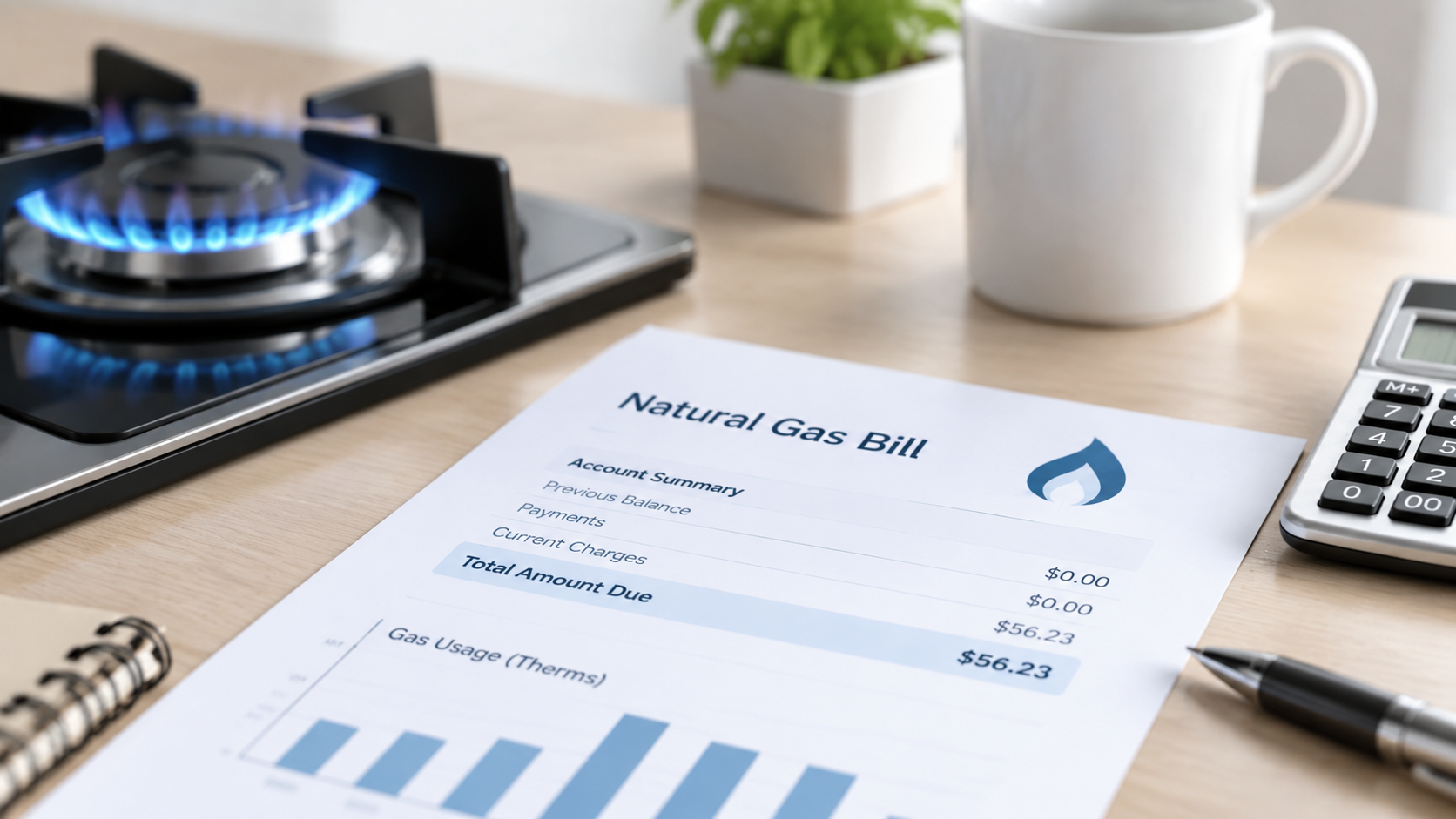
For natural gas calculations, see the sample gas bill, the detailed gas bill charges guide and our guide to reading a gas bill. A fictional gas statement can also be created with the gas bill generator.
Natural-gas billing can involve an additional step because a meter may record gas volume while the bill displays an energy unit such as therms.
A fictional example:
At a fictional price of $1.10 per therm:
| Gas Component | Fictional Amount |
|---|---|
| Gas usage | $34.32 |
| Delivery | $18.00 |
| Customer charge | $9.00 |
| Taxes / fees | $3.10 |
| Total | $64.42 |
Real natural-gas heat content varies. A real account should use the provider's actual meter and conversion information.
How Water Bills Can Be Calculated
Water pricing can include usage charges, tiered rates, base fees, sewer charges and other service-specific items. See water bill charges explained for the detailed charge structure behind these calculations.
Water providers can combine fixed charges with a uniform, tiered or other consumption rate.
Uniform-rate example
Tiered-rate example
Next 3 CCF × $5.50 = $16.50
Total usage charge = $28.50
| Water Component | Fictional Amount |
|---|---|
| Base charge | $18.00 |
| Water usage | $28.50 |
| Sewer / wastewater | $28.00 |
| Other fees | $3.00 |
| Total | $77.50 |
How Internet and Mobile Bills Are Calculated
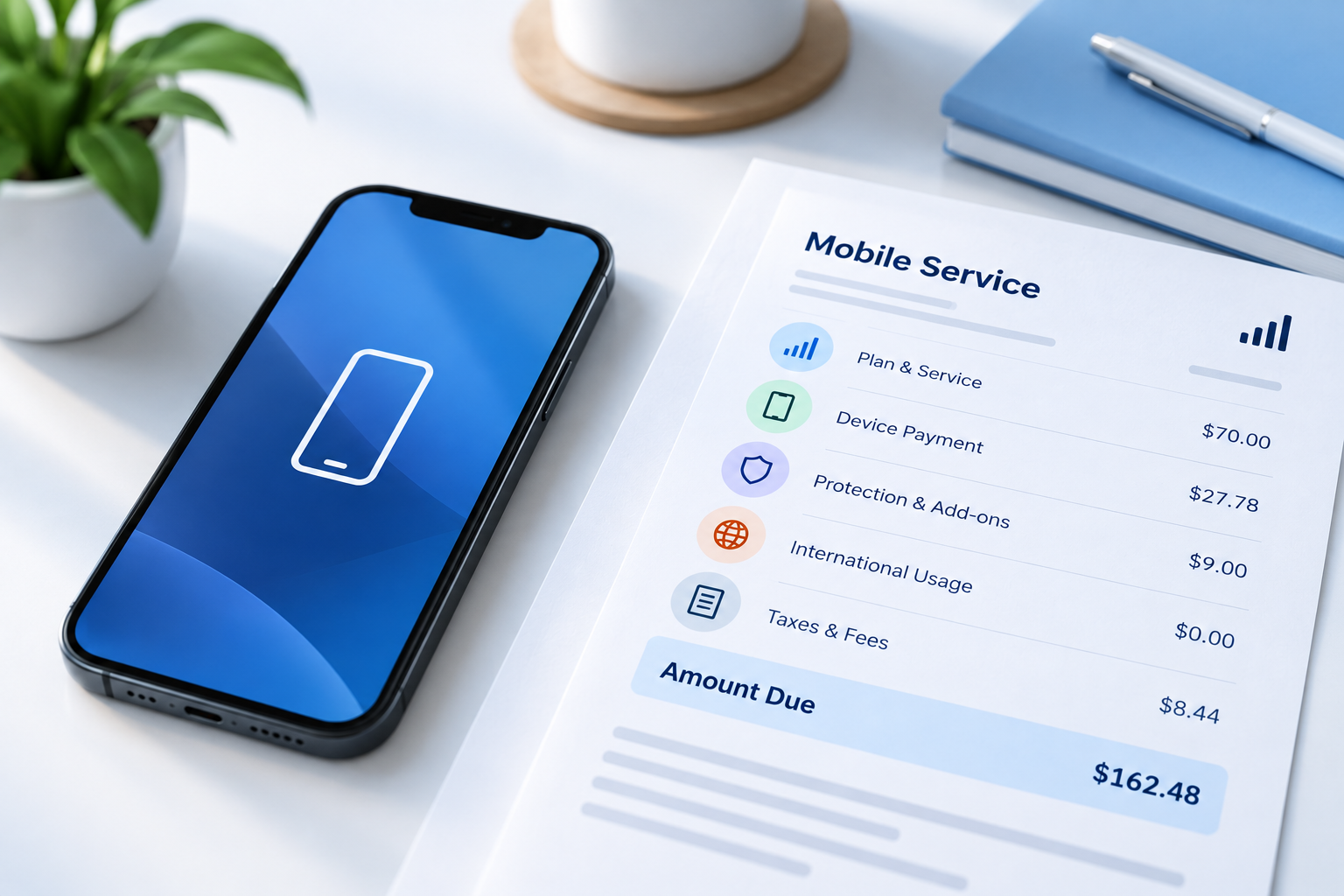
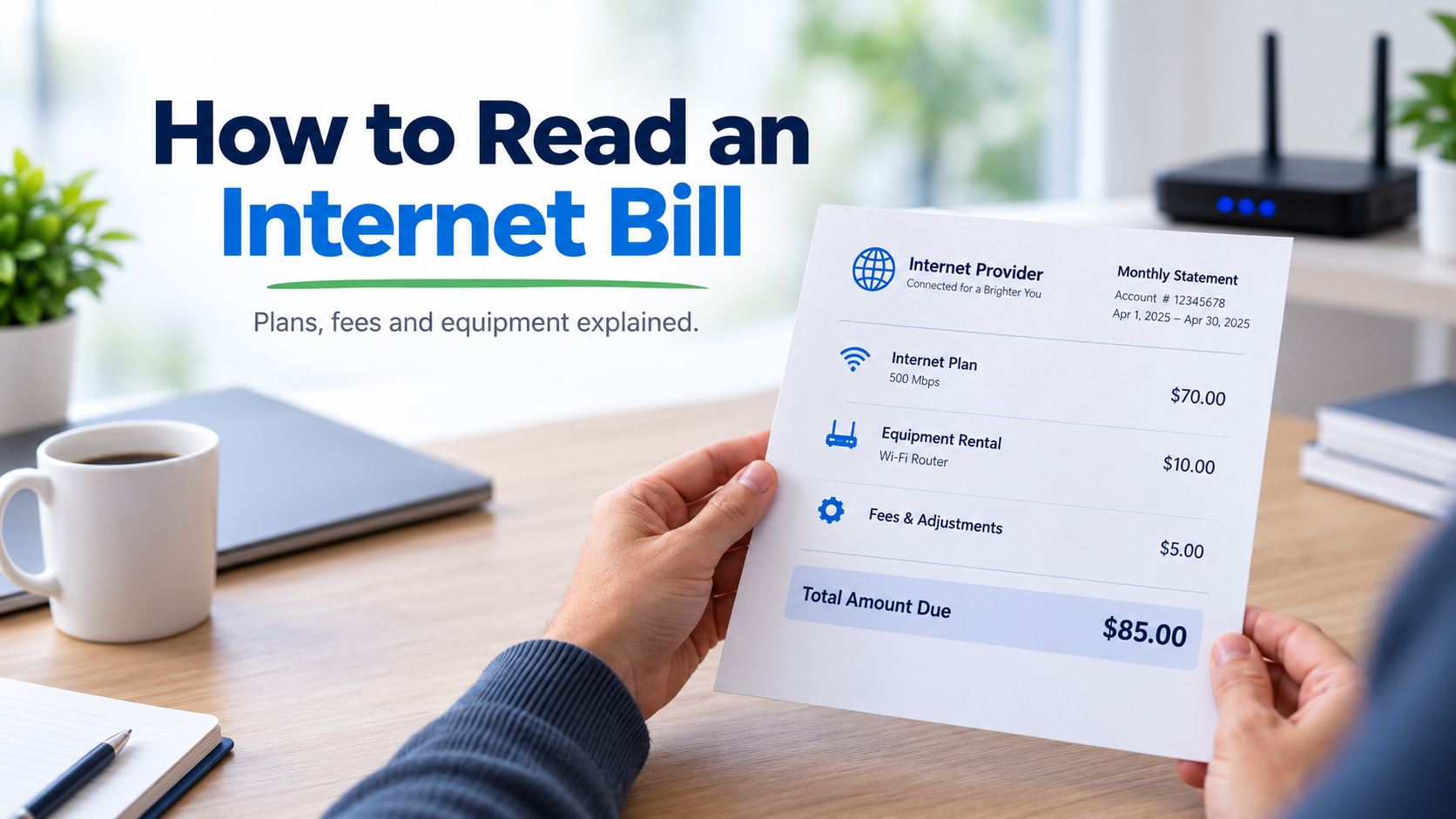
Internet and mobile services usually begin with a subscription plan rather than a utility meter.
| Service Component | Fictional Example |
|---|---|
| Internet plan | $65.00 |
| Equipment rental | $10.00 |
| Additional service | $5.00 |
| Promotional credit | −$10.00 |
| Taxes / fees | $4.25 |
| Total | $74.25 |
Why Can an Actual Meter Reading Cause a Catch-Up Charge?
A provider can sometimes estimate consumption when actual meter data is unavailable.
When an actual reading later becomes available, the difference can be reconciled.
At a fictional rate of $0.18 per unit:
Why Can a Utility Bill Increase When Usage Does Not?
Usage is only one component of a utility statement.
The total can increase because of:
- a higher unit rate;
- a different rate tier;
- time-of-use pricing;
- a longer billing period;
- higher fixed charges;
- higher delivery charges;
- seasonal pricing;
- new fees or riders;
- an expired credit;
- an unpaid previous balance;
- an estimated-reading correction.
Same usage, higher total
| Component | Previous | Current |
|---|---|---|
| Usage | 800 kWh | 800 kWh |
| Energy rate | $0.08 | $0.08 |
| Usage charge | $64 | $64 |
| Delivery | $30 | $38 |
| Fixed charge | $9 | $12 |
| Subtotal | $103 | $114 |
Consumption stayed the same. Other bill components caused the increase.
What If an Apartment Does Not Have Its Own Utility Meter?
Some multifamily buildings use a master account rather than a separate utility meter for every apartment.
Charges may then be allocated using factors such as:
- occupancy;
- square footage;
- number of bedrooms;
- another lease-defined allocation method.
8-Step Utility Bill Calculation Checklist
- Check the billing period. Confirm the service dates and number of billing days.
- Find the usage or service amount. Look for kWh, therms, CCF, gallons or the recurring service plan.
- Normalize usage when comparing bills. Calculate average daily usage if billing periods differ in length.
- Identify the rate structure. Check for uniform, tiered, seasonal or time-based pricing.
- Review fixed and delivery charges. Do not assume usage × rate equals the complete bill.
- Review taxes, fees and adjustments. Look for provider-specific riders or municipal charges.
- Reconcile balances and credits. Check previous balances, payments and account credits.
- Calculate the effective rate. Divide current-period charges by usage when comparing the complete cost per unit.
What Is a Sample Utility Bill?
For a provider-neutral example showing account fields, usage, rates, charges and totals together, review our annotated sample utility bill. Developers and QA teams validating extracted usage, dates, line items and totals can also use our utility bill OCR testing guide.
A sample utility bill is a fictional document created to demonstrate or test the structure of a utility-style statement.
Sample utility bills can be useful for legitimate purposes such as:
- software development and QA testing;
- OCR and document-processing tests;
- UI/UX prototypes and mockups;
- training materials;
- classroom and educational exercises;
- product demonstrations.
A sample created through UtilityBillGenerator.net is not issued by an electricity, gas, water, internet or other utility provider. It is not an official utility-provider record and should not be presented as proof of address, proof of identity, proof of utility service, proof of account ownership or proof of payment.
Frequently Asked Questions
Utility bills generally combine usage or service charges with applicable fixed charges, delivery or distribution costs, taxes and fees, then account for previous balances, payments and credits. Exact calculations vary by utility and service type.
Usually not. Usage multiplied by the rate may calculate only one portion of the statement. Fixed charges, delivery costs, taxes, fees and previous balances can also affect the final amount due.
Electricity bills commonly begin with kWh usage and the applicable rate. Fixed, delivery, distribution, supply, tax or other charges can then be added. Tiered and time-of-use structures can make the calculation more complex.
Natural-gas bills may begin with CCF, Mcf or therm usage. Some providers convert measured volume into energy before applying the rate, then add delivery, fixed charges and applicable fees.
Water bills often combine a fixed base charge with measured consumption. The usage portion can use uniform, tiered, seasonal or another rate structure, while sewer and other municipal charges can also appear.
Rates, fixed charges, delivery charges, billing-period length, taxes, fees, previous balances or expired credits can change even when consumption remains the same.
Effective rate is a comparison metric calculated by dividing current-period charges by consumption. It can show the broader cost per unit after fixed and delivery charges, but it is not necessarily the same as the provider's advertised supply rate.
No. UtilityBillGenerator.net provides fictional sample utility bills only. Samples are not issued, approved, authorized or verified by real utility providers and are not official utility records.
Sample utility bills can be used for legitimate activities such as software testing, OCR development, UI/UX design, training, classroom exercises and demonstrations. They should not be represented as official provider-issued records.
Create a Sample Utility Bill
UtilityBillGenerator.net lets you create customizable sample utility bills for legitimate software development, QA testing, OCR testing, UI/UX mockups, demonstrations, training and educational projects.
Sample bills created through the site are fictional. They are not issued, authorized or verified by real utility providers and are not official utility-provider records.
Create a Sample Utility BillOfficial Sources & Methodology
The educational sections of this guide use provider-neutral explanations because utility rate structures, taxes, units and billing formulas vary across providers and jurisdictions.
- U.S. Department of Energy — Evaluating Your Utility Rate Options
- U.S. Department of Energy — Understanding Your Electricity Bills
- U.S. Energy Information Administration — Natural Gas Units of Measure
- U.S. Energy Information Administration — Natural Gas Conversions
- U.S. EPA WaterSense — Understanding Your Water Bill
All provider names, customer details, rates, conversion factors, usage values and dollar amounts used in the examples on this page are fictional educational examples.