

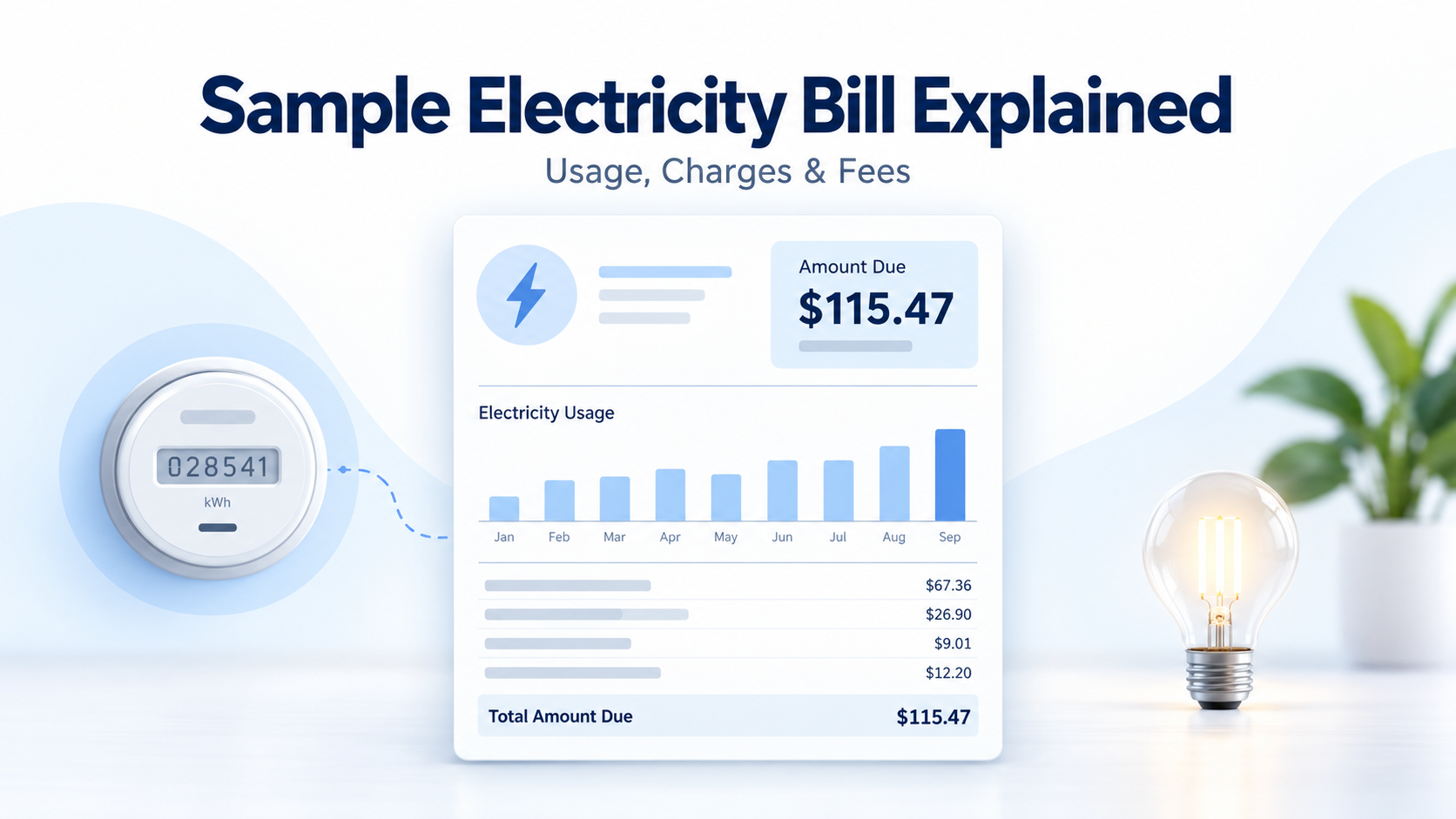
An electricity bill is rarely just electricity usage × one rate. A residential statement can combine meter readings, kWh consumption, generation or supply, transmission, local delivery, fixed charges, rate riders, taxes, credits and previous account activity.
The annotated fictional statement below shows how those pieces connect, how to calculate usage, why the supply rate does not equal the effective cost of the entire bill and how to tell whether a bill changed because of usage, rates or fixed charges.
Annotated Sample Electricity Bill
The sample uses a simple flat-rate residential structure so every number can be audited easily. Later sections explain why many real bills use more complex pricing.
Crestline Electric Services
NOT FOR PAYMENT
Sample City, EX 00000
Payment Stub - Fictional Example
How Electric Meter Readings Become kWh Usage
For a step-by-step explanation of previous readings, current readings, kWh consumption and estimated readings, see our guide on how to read an electricity bill.
A meter multiplier is not required on every residential bill. When a multiplier appears, use the method stated by that utility.
Actual vs Estimated Electricity Readings
Actual
Usage is based on an actual meter reading obtained through the utility's approved meter-reading system.
Estimated
The provider estimates consumption when a usable actual reading is not available.
Estimated-to-Actual Catch-Up
If previous estimated readings understated consumption, a later actual reading can produce a higher bill because part of the difference relates to previously unbilled usage.
Electricity Bill Terms You Should Know
If you encounter unfamiliar billing abbreviations, rate labels or energy units, use our utility bill terms and abbreviations reference for quick definitions.
| Term | Meaning |
|---|---|
| kW | Kilowatt. A measure of power or the rate at which electricity is being used. |
| kWh | Kilowatt-hour. A measure of electrical energy consumed. |
| Supply / Generation | The electricity commodity or generation-related part of the bill. |
| Transmission | High-voltage movement of electricity across the broader grid. |
| Distribution | Local delivery through the utility's poles, wires and related infrastructure. |
| Meter Multiplier | A factor applied to the difference between readings where required. |
| Actual Reading | Usage based on an actual meter reading. |
| Estimated Reading | Usage estimated when an actual meter reading is unavailable. |
| Rider | An additional rate or tariff component that can adjust the amount billed. |
| Tariff / Rate Schedule | The pricing rules that apply to an electricity account. |
Electricity Supply vs Transmission vs Distribution
For a deeper breakdown of supply, transmission, distribution, customer charges and other line items, see electricity bill charges explained.
| Bill Component | General Purpose | Fictional Amount |
|---|---|---|
| Supply / Generation | Electricity commodity or generation-related cost. | $67.36 |
| Transmission | Moving electricity through the high-voltage grid. | $7.50 |
| Distribution / Delivery | Local delivery infrastructure and utility service. | $26.90 |
| Customer Charge | Fixed account/service charge. | $9.00 |
| Taxes & Fees | Applicable taxes, assessments or other bill charges. | $4.71 |
Rate Plans, Tariffs, Suppliers & Service Identifiers
Some bills contain account details beyond basic kWh and charges. Depending on the market and utility, these can include:
- rate schedule or tariff
- generation supplier
- local delivery utility
- service identifier
- customer class
Rate Plan / Tariff
Defines the pricing rules applied to the account.
Supplier
In markets with retail electricity choice, the generation/supply provider can differ from the utility that physically delivers power.
Why Electricity Rate Calculations Can Be More Complicated
The fictional Crestline sample intentionally uses a flat supply rate. Real electricity pricing can use several structures.
| Rate Structure | How It Works |
|---|---|
| Flat | The applicable usage rate stays the same across the included kWh. |
| Tiered | Different blocks of electricity consumption can be priced at different rates. |
| Time-of-Use | Electricity price can vary according to the time period when energy is used. |
| Seasonal | Rates or usage allowances can change between seasons. |
| Demand-Based | Some accounts can be charged partly according to peak demand measured in kW. |
| Solar / Net Billing | Grid imports, exports and generation credits can affect the statement. |
Tiered Rate Example
Suppose a fictional tiered plan charges:
- first 500 kWh at $0.0700
- remaining 342 kWh at $0.0950
In a tiered structure, calculating:
would not accurately reproduce the charge.
Time-of-Use Example
With time-of-use pricing, electricity used at different times can carry different prices.
Why Does kWh × Electricity Rate Not Equal the Total Bill?
Electricity usage is only one part of the total statement. For broader formulas covering usage, fixed charges, rates, billing periods and effective costs, see how utility bills are calculated.
The fictional supply rate is:
So the supply component is:
But total current charges are:
Effective Total Bill Cost per kWh
This is a useful educational blended calculation, but it is not necessarily the official tariff, supply rate or advertised electricity price.
What Is a Price-to-Compare on an Electricity Bill?
In some competitive electricity markets, a utility can provide a price-to-compare that customers can use when evaluating supply offers.
The exact definition depends on the utility and jurisdiction. It should not be confused with:
- the total amount due
- the effective total bill cost per kWh
- the delivery charge
Current Electricity Charges vs Amount Due
The current electricity charges are not always the same as the final balance due. Our utility bill account summary guide explains previous balances, payments, credits, current charges, billing dates and the amount due.
| Account Activity | Amount |
|---|---|
| Previous balance | $108.40 |
| Payment received | −$108.40 |
| Remaining prior balance | $0.00 |
| Current electricity charges | $115.47 |
| Amount due | $115.47 |
13-Month Electricity Usage History
Many electric bills provide historical kWh usage so customers can compare the current month with recent periods and the same month last year.
| Comparison | Usage | Billing Days | Average kWh/Day |
|---|---|---|---|
| Same month last year | 780 kWh | 30 | 26.0 |
| Previous month | 805 kWh | 31 | 26.0 |
| Current month | 842 kWh | 30 | 28.1 |
For the most recent 12 fictional months shown above:
- Total usage: 9,128 kWh
- Average monthly usage: about 761 kWh
- Current average daily bill cost: about $3.85/day
Why Weather Can Affect Electricity Usage
Heating and cooling equipment can materially change electricity demand, so some real utility statements show temperature information alongside usage history.
A month with similar billing days can still have substantially different kWh usage because of:
- hotter weather and increased air conditioning
- colder weather and electric heating
- changes in occupancy
- new appliances or equipment
Why Did This Electricity Bill Change?
A useful bill comparison separates three major drivers:
Electric Bill Change Diagnostic
Estimate how much of a period-to-period change came from consumption, the usage rate and non-usage charges.
Why Some Electricity Bills Look Very Different
If your project needs a different type of fictional billing statement, start with our utility bill generator to review the available sample bill options before choosing the service-specific tool.
Residential vs Commercial Electricity Bills
Residential
Usually emphasizes energy consumption in kWh.
Commercial / Industrial
Can include both kWh energy and kW demand, plus more detailed delivery or demand-related charges.
Solar & Net Billing
A solar electricity statement can contain concepts that do not appear on a simple non-solar residential bill.
Depending on the program, those can include:
- electricity imported from the grid
- electricity exported to the grid
- generation credits
- net usage
- current and year-to-date credits
- true-up or annual settlement mechanisms
Budget Billing vs Actual Electricity Cost
A budget-billing program can smooth monthly payments by using an average or calculated payment amount.
| Figure | Meaning |
|---|---|
| Actual electric charges | The energy and service cost generated by the current billing period. |
| Budget payment | The scheduled payment amount under the budget-billing program. |
| Deferred / accumulated balance | The difference that can build between budget payments and actual costs, depending on the provider's program. |
Electricity Bill Calculators
Electric Meter Usage Calculator
Electricity Supply Charge Calculator
Average Daily Electricity Usage Comparator
Effective Electricity Cost per kWh
Real Electricity Bill vs Fictional Sample
For a broader annotated example covering the sections shared across different utility types, see our sample utility bill. Developers testing recognition or document extraction can also use our utility bill OCR testing guide for ground truth, field validation and QA workflows.
| Real Electricity Bill | Fictional Educational Sample |
|---|---|
| Issued by an actual utility or supplier | Created as an example |
| Connected to a genuine account | No real account relationship |
| Uses actual meter and billing data | Uses fictional values |
| Uses real tariff/rate rules | Uses simplified educational pricing |
| Documents actual service history | Cannot verify electricity service |
| Obtained through the provider | Generated for testing or education |
Create a Sample Electricity Bill
Need a fictional electricity statement for software testing, OCR testing, QA, classroom use, training or interface mockups?
Use the sample electricity bill generator to create an educational fictional statement with electricity-specific fields.
Create a Fictional Electricity Bill Sample
When you need to build another fictional billing example from the main site, you can create a utility bill online and then select the supported bill type that best matches your testing, mockup or educational use case.
Enter sample account details, electricity usage and fictional charges for a testing, training or demonstration project.
Generated documents are not official electricity records and cannot verify address, identity, service, account ownership or payment.
Create a Sample Electricity BillRelated Electricity & Utility Bill Guides
Continue with the related guides below for electricity reading, charges, calculations and billing terminology. For technical document testing and data extraction, see Utility Bill OCR Testing.
Frequently Asked Questions
What information appears on an electricity bill?
An electricity bill can include account details, rate plan, billing period, meter readings, kWh usage, supply, transmission, distribution, fixed charges, taxes, payments and amount due.
How is kWh calculated from an electric meter?
A simplified calculation subtracts the previous reading from the current reading and applies any required meter multiplier.
Why does kWh multiplied by my supply rate not equal my total bill?
The supply rate can represent only one component. Transmission, delivery, fixed charges, taxes, riders and other account activity can also affect the total.
What is a tiered electricity rate?
A tiered rate charges different prices for different blocks of electricity usage rather than applying one price to every kWh.
What is a time-of-use electricity rate?
Time-of-use pricing applies different rates depending on when electricity is consumed, such as peak and off-peak periods.
What is a price-to-compare?
In some competitive electricity markets, it is a utility-defined benchmark used to compare eligible electricity supply offers. Not every bill uses this term.
What is the difference between kW and kWh?
kW measures power or demand, while kWh measures electrical energy consumed over time.
Why should I compare kWh per day?
Billing periods can have different lengths. Dividing total kWh by billing days gives a more comparable daily-use figure.
Why can an actual meter reading cause a higher bill?
If prior estimated readings understated consumption, a later actual reading can reconcile part of the difference.
Why does weather matter to an electricity bill?
Heating and cooling demand can change electricity consumption substantially, especially during unusually hot or cold periods.
What is average daily bill cost?
It is the current bill amount divided by the number of billing days. In this fictional example, $115.47 divided by 30 is about $3.85 per day.
Why do commercial electricity bills look different?
Commercial accounts can include demand charges measured in kW in addition to energy consumption measured in kWh.
How can solar change an electricity bill?
Solar billing can introduce grid imports, exports, generation credits, net usage and provider-specific settlement or true-up mechanisms.
Is budget billing the same as the actual monthly energy cost?
Not necessarily. Budget billing can smooth payments based on average costs, while actual energy charges continue to accumulate according to the provider's rules.
Can a sample electricity bill be used as proof of address?
No. A fictional sample is not issued or verified by a real electricity provider and cannot establish residence, identity, service or account ownership.
Where can I create a fictional electricity bill sample?
For legitimate testing, education and demonstration projects, use the sample electricity bill generator .
Editorial Sources
This provider-neutral guide was cross-checked against current electricity bill education from major U.S. utilities and energy providers.
- AEP Ohio - Understanding Your Bill for supply, delivery, usage history and payment-stub concepts.
- Reliant - Understanding Your Electricity Bill for meter usage, multipliers, average price and account structure.
- Con Edison - Residential Sample Bill for billing summaries, average daily usage, temperature context and next-read information.
- PG&E - Tiered Rate Plan for tiered electricity-pricing concepts.
- PG&E - Solar Billing Plan for solar charge-and-credit concepts.
Actual rates, tariffs, suppliers, taxes, meter methods and billing procedures vary by utility and jurisdiction.