
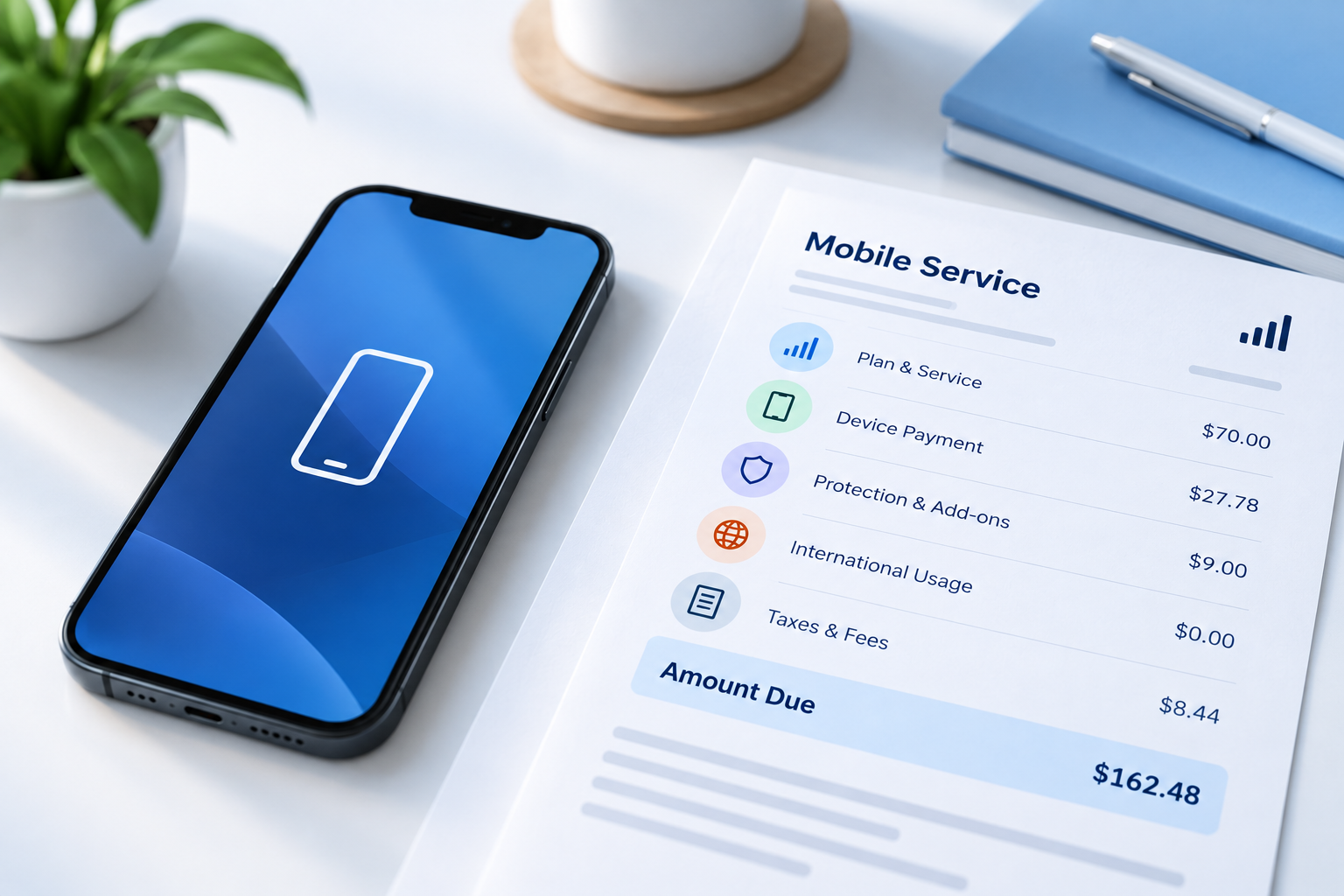
A mobile phone bill can contain several different types of money moving in opposite directions at the same time: service charges, device installments, promotional credits, discounts, add-ons, international usage, taxes and one-time activity.
The fastest way to make sense of the total is to separate the account from each individual mobile line, then match every device payment with any related promotional credit.
This guide goes one step further. It shows you what is recurring, what may disappear next month, what can arrive late, how cancellation can affect device payments, and how to identify the exact line that caused an unexpected increase.
1. Understand Your Mobile Phone Bill
Prepaid vs Postpaid Mobile Billing
Before reading the statement, identify the type of account.
| Postpaid | Prepaid |
|---|---|
| Usually produces a recurring bill or account statement. | Service is generally funded before use. |
| Can contain previous balances and current charges. | Often centers on account balance, refill or renewal activity. |
| Commonly supports device installments and monthly promo credits. | Device-financing options depend on the provider and product. |
| Can contain partial-month, usage and one-time charges. | May use payment and refill history instead of a complex statement. |
Mobile Bill Anatomy
| Bill Section | What It Usually Means |
|---|---|
| Account summary | Previous balance, payments, credits, current charges and amount due. |
| Billing period | The period associated with recurring service. |
| Account-level charges | Shared or account-wide service and credits. |
| Charges by line | Service, device and usage tied to a specific line. |
| Device payments | Installments on financed phones, watches or tablets. |
| Promotional credits | Recurring credits linked to eligible device or service offers. |
| Usage | Data, international activity or other usage-based items. |
| Taxes / fees | Government and provider-related charges where applicable. |
Billing Date vs Billing Period vs Due Date
| Date | Meaning |
|---|---|
| Billing date | The date the statement was produced. |
| Billing period | The service period associated with recurring charges. |
| Change date | The date a new line, plan or feature took effect. |
| Due date | The payment deadline. |
Account-Level vs Line-Level Charges
Account-Level
- shared plan charges
- account discounts
- previous balance
- certain taxes and fees
- shared benefits
Line-Level
- individual line service
- device installment
- device promotional credit
- protection
- international usage
- line-specific add-ons
Are You Paying in Advance or After Use?
A mobile statement can contain charges from different time periods.
Some carriers bill recurring monthly service in advance while non-recurring usage is billed after it occurs.
2. Plans, Lines, Data & Connected Devices
Start by identifying the main mobile plan and its recurring monthly charge. Depending on the carrier, each phone, tablet or connected device may also have a separate line charge or access charge. Plans may include a fixed amount of data or be described as unlimited, while equipment and connected-device charges can appear separately from wireless service.
Wireless Plan Charges
The core wireless-plan portion pays for mobile network service and the features included in the selected plan.
Depending on the plan, that can include:
- voice calls
- text messaging
- mobile data
- 5G access
- premium-data allowances
- mobile hotspot
- international features
- streaming or other plan perks
Family and Multi-Line Billing
A multi-line bill should not be evaluated as if it were one large single-line charge.
Each line can have a different combination of:
- device payment
- promotion
- protection
- international usage
- add-ons
Why Is My Smartwatch or Tablet on My Phone Bill?
A connected smartwatch or tablet can have its own mobile service line even when it is paired with a phone.
Possible charges include:
- monthly connected-device line fee
- tablet or watch device payment
- taxes and regulatory fees
- data service
What Does a Phone Bill Show About Calls, Texts and Data?
The exact detail depends on the carrier and bill format.
A statement or detailed account view can potentially show:
- call records or usage
- text-message usage records
- mobile-data usage
- international activity
- usage assigned to each line
3. Devices, Trade-Ins & Promotional Credits
How Device Installment Payments Work
A financed device creates a payment that is separate from wireless service.
Fictional example
Retail device price: $999
Down payment: $99
Financed amount: $900
36-month simplified term:
Remaining Device Balance
Your account may separately display:
- current installment
- remaining installments
- remaining balance
- device promotional credit
Trade-In and Device Promotional Credits
Fictional example
| Line Item | Amount |
|---|---|
| Device installment | $27.78 |
| Device promotional credit | −$22.22 |
| Net device impact | $5.56 |
Why Does a “Free Phone” Still Show a Device Payment?
A promotional device can still show a normal installment on the bill. The promotion may be delivered through a separate monthly credit.
Why Is My Trade-In or Promo Credit Not Showing Yet?
Credit timing depends on the carrier and the specific promotion.
Some device offers can take one or more bill cycles to begin. A later bill may contain:
- the normal current credit
- one or more catch-up credits
What Happens If I Pay Off the Phone Early?
Device payoff and promotional-credit eligibility are separate questions.
A provider can allow early device payoff while still ending future promotion credits under the applicable offer.
Why Do I Still Owe Money on a Promotional Phone After Cancelling?
A “free” or discounted phone promotion and the device-financing agreement are not the same thing.
Cancellation can cause:
- future promotional credits to stop
- remaining device balance to continue or become due, depending on carrier rules
- multi-line or service discounts to change
Why Did I Pay Tax on a “Free” Phone?
Promotional price and taxable value are not always the same thing.
Depending on jurisdiction and carrier billing rules, tax on a device can be due even when monthly promotional credits eventually offset the device's installment cost.
4. First Bills, Billing Changes & Extra Charges
Also check whether an autopay or paperless billing discount is included in the advertised price. A new line, plan change or billing-cycle adjustment can create a prorated partial month charge before the next full recurring billing period begins.
Why Is My First Phone Bill So High?
A device promotion can make the first bill even more confusing if the device payment appears before its expected promotional credit.
Prorated Plan Charges
A mid-cycle plan change, new line or service adjustment can create partial-month charges and credits.
Why Did My Bill Change After Moving My Due Date or Billing Cycle?
A billing-cycle change can create a transition period that is longer or shorter than the normal monthly cycle.
That can produce:
- partial recurring service charges
- partial service credits
- different discount timing
- a temporarily higher or lower statement
Device installments do not necessarily follow the same proration logic as monthly service.
Activation, Upgrade and Device Connection Charges
| Charge | Possible Trigger |
|---|---|
| Activation fee | Starting a new line or service. |
| Upgrade fee | Upgrading a device on an existing line. |
| Device connection charge | Carrier-specific activation or upgrade process. |
| Setup / assisted-service fee | Provider or retail assistance. |
Government Taxes vs Carrier Recovery Fees
These should not be treated as interchangeable.
| Charge Type | What It Means |
|---|---|
| Government Tax | Tax imposed by an applicable government authority. |
| Government Assessment / Fee | Government-imposed charge such as an applicable 911 assessment. |
| Carrier Recovery Fee | A provider-imposed fee used to recover certain operational or regulatory-related costs. |
| Carrier Service Fee | Provider charge associated with activation, upgrade, payment support or another service. |
| Third-Party Purchase | Separate purchase or service billed through the mobile account. |
Restocking and Non-Return Charges
A charge after returning or exchanging a device does not always mean the monthly wireless plan changed.
Possible reasons include:
- restocking fee
- return not yet processed
- missed return deadline
- wrong device returned
- damage
- provider-specific non-return fee
International Calling vs Roaming
| Charge | Meaning |
|---|---|
| International calling | Calling another country. |
| International roaming | Using service while connected to a foreign mobile network. |
| Travel pass / add-on | Optional international feature where offered. |
| Pay-per-use activity | International service billed individually. |
Why Is an International Charge Appearing Now?
Usage charges are not always posted immediately. International or other non-recurring activity may appear on a later statement than the month in which it happened.
Carrier Billing and Third-Party Purchases
Some purchases can be charged through a mobile account rather than directly to a payment card.
Depending on carrier and eligibility, these can include:
- apps or digital content
- subscriptions
- accessories
- carrier services
- other eligible purchases
5. Diagnose an Unexpected Mobile Phone Bill
Why Did My Phone Bill Increase?
| Change | Likely Area to Check |
|---|---|
| Plan amount increased | Rate or plan change |
| Only one line increased | Device, credit, add-on, protection or usage on that line |
| Device installment appeared | New financed phone or connected device |
| Device credit disappeared | Promotion eligibility or term change |
| First bill is high | Partial period + full period + setup activity |
| International section increased | Calling, roaming or delayed international activity |
| Fees increased | Tax, government assessment, provider recovery or carrier-service fee |
| Current charges stayed similar but amount due rose | Previous balance |
What Happens on a Final Mobile Bill?
A cancelled mobile account can still generate additional billing activity.
Check for:
- cancellation date
- last recurring-service period
- final usage
- late-posting international charges
- remaining device balance
- stopped device promotional credits
- unreturned or restocking charges where applicable
- refunds or account credits
- taxes and fees
What If I Do Not Recognize a Charge?
- Determine whether it is account-level or line-level.
- Identify the company or product name.
- Check recent upgrades and add-ons.
- Ask other authorized account users.
- Review carrier-billed purchases.
- Check order and trade-in confirmations.
- Contact the carrier if the charge is still unexplained.
What Is Cramming?
The FCC uses cramming to describe unauthorized charges placed on a telephone bill.
6. Mobile Phone Bill Tools
For a provider-neutral example showing account information, billing dates, balances and itemized charges together, review our annotated sample utility bill. For customizable fictional document testing, you can also use the online utility bill generator.
Annotated Fictional Mobile Bill
This example is entirely fictional and is included only to demonstrate billing structure.
Crestline Mobile Services
Mobile Bill Reconstruction Tool
Separate recurring service, devices, credits and unusual charges.
Device Payment & Promotion Calculator
Model the device agreement separately from the promotional-credit term.
First Mobile Bill Calculator
Estimate temporary first-bill effects, including a device credit that has not started yet.
Which Mobile Line Caused the Increase?
Compare the previous total for each line with the current line components.
Will This Charge Repeat Next Month?
| Charge | Typical Pattern |
|---|---|
| Wireless plan | Recurring |
| Phone line | Recurring |
| Watch / tablet line | Recurring while active |
| Device payment | Recurring until device agreement ends or is otherwise resolved |
| Device promo credit | Recurring while eligible under the promotion |
| Protection | Recurring while active |
| Auto Pay discount | Recurring while eligibility requirements are met |
| Prorated service | Usually temporary |
| Activation / upgrade | Usually one-time |
| International usage | Usage-dependent |
| Carrier-billed purchase | One-time or recurring depending on the purchase |
| Previous balance | Carries forward until paid or adjusted |
7. 35-Point Mobile Phone Bill Audit Checklist
Developers and QA teams working with billing-document extraction can also review the utility bill OCR testing guide for testing fields such as account numbers, billing dates, line charges, device payments, credits, taxes, fees and totals.
- Identify whether the account is prepaid or postpaid.
- Confirm the account number.
- Confirm the billing date.
- Confirm the billing period.
- Confirm the due date.
- Separate previous balance from current charges.
- Identify account-level charges.
- Identify every active phone line.
- Identify tablet and smartwatch lines.
- Review the wireless plan.
- Review family or multi-line discounts.
- Review voice, text and data usage.
- Check hotspot or data add-ons.
- Identify every device installment.
- Check remaining device balances.
- Match device payments with promotional credits.
- Check whether device promo credits have started.
- Check for catch-up promotional credits.
- Review the promotion eligibility requirements.
- Check before paying a promotional device off early.
- Review device-protection charges.
- Check Auto Pay and other service discounts.
- Review connected-device service lines.
- Check activation or upgrade fees.
- Check carrier recovery fees separately from taxes.
- Check government taxes and assessments.
- Review partial-month activity.
- Check whether a billing-cycle change affected the statement.
- Review international calling.
- Review international roaming.
- Check carrier-billed purchases.
- Investigate every unfamiliar charge.
- Determine what will repeat next month.
- Compare each line with the prior bill.
- Reconcile the calculated total with current charges.
8. Frequently Asked Questions
How do I read a mobile phone bill?
Start with the account summary, separate account-level charges from individual lines, then review service, device payments, promotional credits, protection, usage, taxes and one-time charges.
What is the difference between prepaid and postpaid?
Postpaid service normally generates an account statement after or around a billing cycle, while prepaid service is generally funded before use through a balance, refill or renewal system.
Why is my phone bill so high?
Common causes include a new device installment, missing promotional credit, plan change, international activity, protection, connected-device lines, one-time fees or a previous balance.
Why is my first phone bill so high?
The first bill can combine partial service, the first full period, device charges, protection, activation, upfront taxes and other fees. A device promo credit may also begin later than the device payment.
Why does a free phone still show a payment?
Many device promotions work through monthly bill credits. The device installment can remain visible while a separate promotional credit offsets some or all of it.
Why is my trade-in credit not showing?
Processing time varies by carrier and offer. Some promotions take one or more billing cycles to begin and may later apply catch-up credits.
What happens if I pay off a promotional phone early?
Carrier and offer rules differ. Some promotions stop future bill credits when the device agreement is paid off early, so check the exact terms first.
Why do I still owe money on a phone advertised as free?
The device financing agreement and the promotional credits are separate. If credits stop because eligibility ends, the remaining financed device balance can still be owed.
Why did I pay tax on a free phone?
Promotional credits and tax treatment are separate. Depending on the jurisdiction and transaction, taxes can apply even when monthly credits offset the device price over time.
Why did my bill increase after changing my due date?
Changing the billing cycle can create a transition period with partial service charges or credits. Device installments and service charges may not follow identical proration rules.
Why is my smartwatch on my phone bill?
A connected smartwatch can have its own wireless service line, device payment and applicable taxes or fees.
What is a carrier recovery fee?
A carrier recovery fee is a provider-imposed charge used to recover certain costs. It should not automatically be treated as a government tax.
What is international roaming?
International roaming generally means using mobile service while connected to a foreign mobile network. It is different from calling another country from your normal service location.
Why did an international charge appear weeks later?
Some usage activity can be reported to the carrier after a delay, so international or other non-recurring usage can appear on a later bill.
What happens to my device payment when I cancel service?
Carrier rules differ. Some carriers can accelerate the remaining device balance when an account closes, while others can continue device installments after mobile service is disconnected.
What is cramming?
Cramming is an unauthorized charge placed on a telephone bill. An unfamiliar company, service or recurring charge should be investigated.
Does a phone bill show who I called?
Some carriers provide call or message usage records in detailed statements or account views. The exact information depends on the carrier and bill format.
Does a phone bill show text message content?
Ordinary billing records can show messaging activity or usage, but billing detail is not the same as a record of the actual message content.
Will my phone bill drop after the device is paid off?
The device installment can end when the financing agreement is completed, but any promotional credit tied to that same agreement can also end. Compare both lines before estimating the new bill.
Does UtilityBillGenerator.net issue official phone bills?
No. UtilityBillGenerator.net provides fictional sample utility documents only. They are not issued, approved, authorized, certified or verified by wireless carriers.
Create a Sample Utility Bill
UtilityBillGenerator.net creates fictional sample utility documents for legitimate software development, QA, OCR testing, UI/UX mockups, demonstrations, training and education.
Samples are not issued, approved, authorized, certified or verified by real wireless carriers and are not proof of address, identity, account ownership, service or payment.
Create a Sample Utility BillEditorial Sources & Verification
The billing concepts in this guide were cross-checked against current carrier and consumer-support documentation from:
- Verizon for billing in advance, device payments, promotional credits, final bills, international charge timing and account cancellation.
- T-Mobile for recurring device credits, bill-cycle changes, provider recovery fees, Auto Pay effects and cancellation/device-balance rules.
- Xfinity Mobile for line-level billing, connected smartwatch/tablet fees, call/message history, international charges and post-disconnection device payments.
- AT&T for first-bill structure, advance recurring charges, partial-month billing and taxes/surcharges.
- FCC consumer guidance for unauthorized phone-bill charges and cramming.
Carrier rules, taxes, promotional credits, device agreements, billing cycles, connected-device charges and final-bill procedures vary. Use the carrier's current service agreement, device-financing agreement, promotion terms and account statement when checking a real bill.
Disclaimer: This page provides general educational information about mobile-phone billing. The fictional formulas and calculators do not replace carrier agreements, promotion terms or device-payment contracts. UtilityBillGenerator.net provides fictional sample utility documents only and does not issue, authorize, certify or verify actual carrier bills.