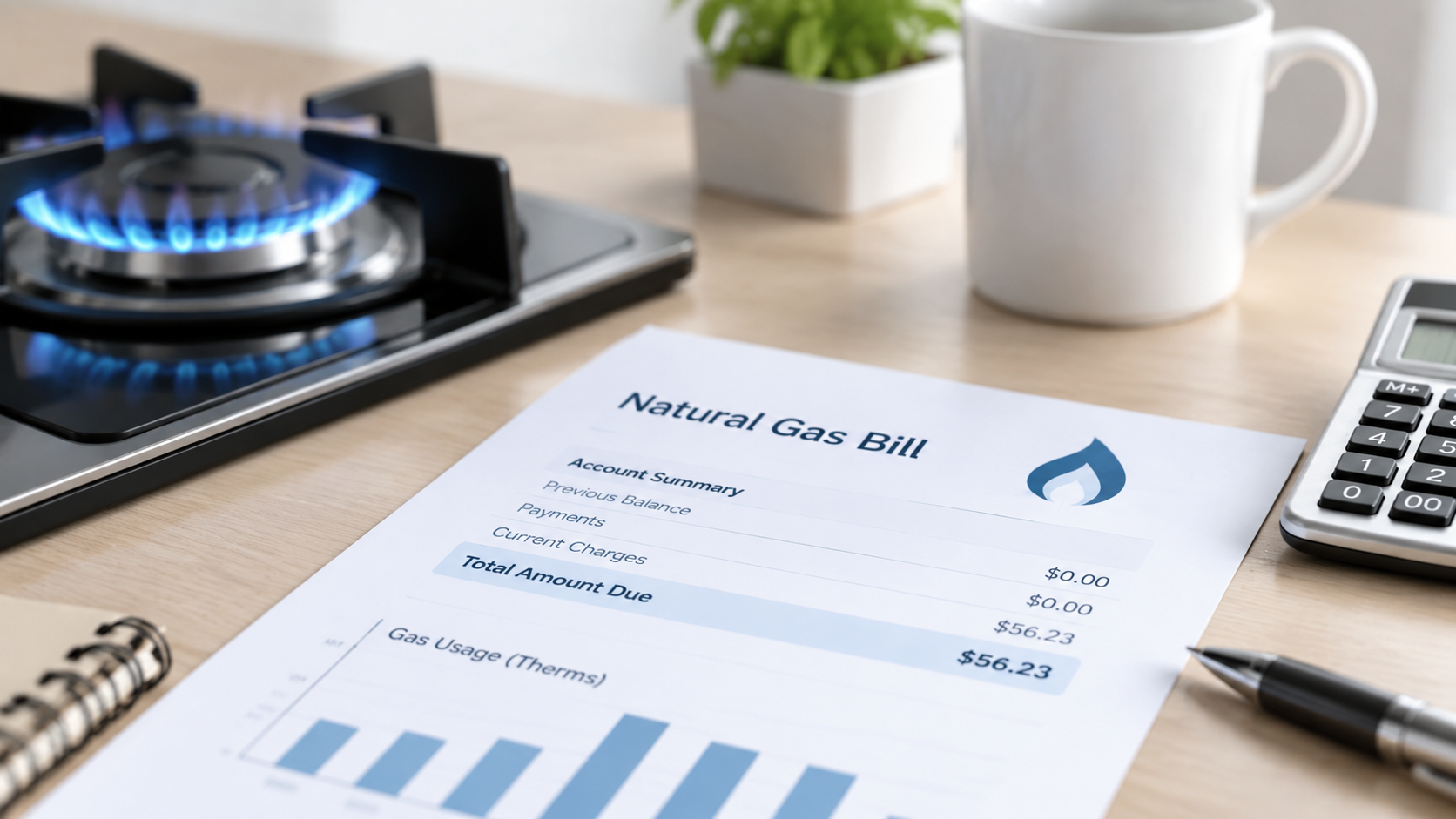

A natural gas bill can involve more steps than simply multiplying a meter reading by one price. The meter may record gas volume, while the statement bills energy in therms.
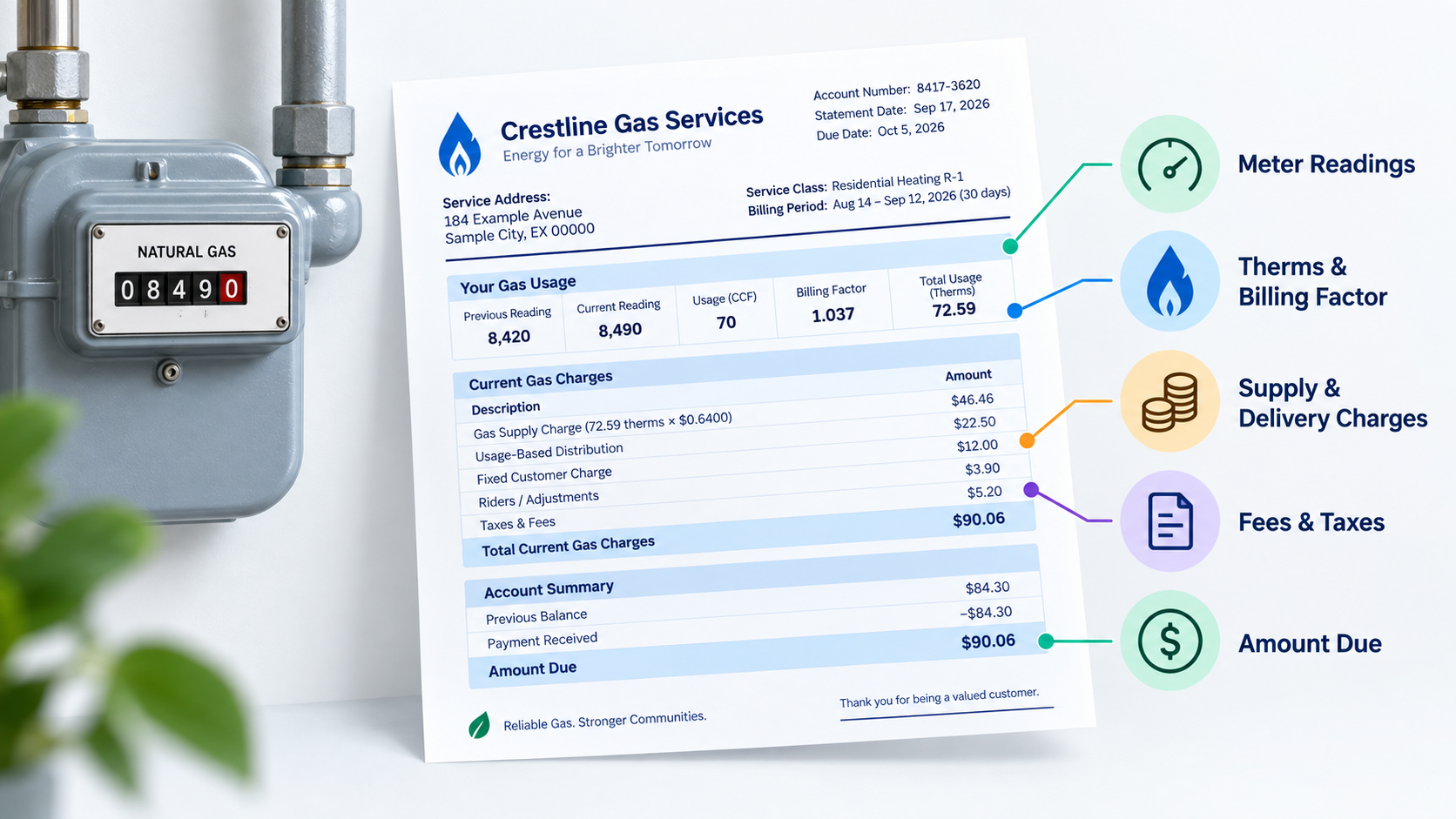
This fictional sample shows how meter readings become CCF, how a billing or heat-content factor can convert CCF into therms, and how gas supply, delivery, customer charges, riders, taxes and account activity combine to produce the final amount due.
Complete Annotated Sample Gas Bill
This fictional example uses a residential heating account with CCF meter readings that are converted into therms. Real utilities can use different units, service classes and pricing rules.
Crestline Gas Services
NOT FOR PAYMENT
Sample City, EX 00000
Payment Stub - Fictional Example
How Gas Meter Readings Become Billable Usage
For a step-by-step explanation of previous and current meter readings, actual versus estimated readings, CCF usage and therms, see our guide on how to read a gas bill.
The fictional meter readings are:
That 70 CCF represents measured gas volume. It is not yet the final energy quantity used by this fictional bill.
Natural Gas Billing Units: CCF, Mcf, Btu & Therms
If terms such as CCF, Mcf, Btu, therms or billing factors are unfamiliar, see our utility bill terms and abbreviations guide for quick definitions across gas and other utility statements.
| Unit | Meaning |
|---|---|
| cf | One cubic foot of natural gas volume. |
| CCF / Ccf | 100 cubic feet. |
| MCF / Mcf | 1,000 cubic feet. |
| Btu | British thermal unit, a measure of heat energy. |
| Therm | 100,000 Btu. |
| MMBtu | 1,000,000 Btu. |
How CCF Is Converted to Therms
The fictional sample uses:
What Is a Natural Gas Billing Factor?
A gas utility can use a billing factor when converting measured gas volume into the energy quantity used for billing.
Depending on the utility's method, factors related to the conversion can reflect concepts such as:
- natural-gas heat content
- delivery pressure
- altitude
- meter calibration or characteristics
- provider-specific conversion rules
Actual, Estimated & Customer-Supplied Gas Readings
Actual Reading
The provider has a usable reading from the meter or approved metering system.
Estimated Reading
The provider estimates usage when a usable actual reading is unavailable.
Customer-Supplied Reading
Some utilities permit customers to submit meter readings under defined circumstances and validation rules.
Why an Actual Reading Can Produce a Higher Later Bill
If earlier estimated readings understated consumption, a later actual reading can capture part of the difference.
Heating vs Non-Heating Gas Service
Natural-gas accounts can be assigned different service classes depending on the customer's use and the utility's tariff structure.
Heating Service
Natural gas is used as a primary source of space heating.
Non-Heating Service
Gas can be used for water heating, cooking, dryers or other appliances without being the primary space-heating fuel.
Gas Supply, Distribution, Fixed & Volumetric Charges
For a deeper explanation of gas supply, distribution, customer charges, fixed fees, volumetric charges and common adjustments, see Gas Bill Charges Explained.
| Charge Type | How It Generally Works | Fictional Example |
|---|---|---|
| Gas Supply / Commodity | Price of the natural gas commodity. | $46.46 |
| Usage-Based Distribution | Delivery charge that changes with gas consumption. | $22.50 |
| Fixed Customer Charge | Account/service charge that can apply even when usage is low. | $12.00 |
| Riders / Adjustments | Approved utility, regulatory or program-related adjustments. | $3.90 |
| Taxes & Fees | Applicable government assessments or other charges. | $5.20 |
Fixed vs Volumetric Gas Charges
Fixed
Does not directly depend on current therm or CCF consumption.
Example: customer/service charge.
Volumetric
Changes according to the amount of natural gas consumed.
Example: usage-based commodity or distribution charge.
Common Gas Riders & Surcharges
Depending on the utility, charges can relate to:
- infrastructure investment
- energy-efficiency programs
- customer-assistance programs
- gas-cost adjustments
- balancing or reconciliation mechanisms
- regulatory surcharges
Default Gas Supply vs Competitive Supplier
In some competitive natural-gas markets, the company supplying the gas commodity can differ from the local utility that delivers it.
Utility / Default Supply
Gas supply is arranged under the utility's applicable default or standard supply program.
Competitive Supplier
An eligible third-party supplier provides or prices the gas commodity where customer choice is available.
What Is a Purchased Gas Adjustment?
Some natural-gas utilities use terms such as Purchased Gas Adjustment, gas cost adjustment, fuel charge or similar mechanisms to reflect changing gas-supply costs.
This matters because:
Baseline, Tiered & Seasonal Gas Rates
The fictional Crestline statement uses one simple commodity rate. Real gas pricing can be more complicated.
| Rate Structure | How It Can Work |
|---|---|
| Flat | One applicable rate is used for the relevant gas quantity. |
| Baseline / Tiered | A defined amount of usage can receive one rate while higher usage receives another. |
| Seasonal | Rates or allowances can change according to season. |
| Supplier Choice | Commodity pricing can depend on the selected or default supplier. |
| Fixed + Usage-Based Delivery | A bill can combine fixed customer charges with volumetric delivery costs. |
Fictional Baseline Example
Suppose a fictional utility defined:
| Usage Block | Fictional Usage |
|---|---|
| Baseline | First 50 therms |
| Above Baseline | Remaining 22.59 therms |
If those two blocks used different rates, this calculation would be wrong:
Each rate block would need to be calculated separately.
Why Does Therms × Gas Rate Not Equal the Total Bill?
Gas usage is only one part of the final statement. For broader formulas covering usage, rates, fixed charges, billing periods and effective costs, see how utility bills are calculated.
But the fictional statement totals:
Effective Total Bill Cost per Therm
This blended calculation spreads the total current charges across the therms used.
Current Gas Charges vs Amount Due
Current gas charges are not always identical to the final amount due. Our utility bill account summary guide explains previous balances, payments, credits, current charges, billing dates and the final balance.
| Account Activity | Amount |
|---|---|
| Previous balance | $84.30 |
| Payment received | −$84.30 |
| Remaining prior balance | $0.00 |
| Current gas charges | $90.06 |
| Amount due | $90.06 |
13-Month Natural Gas Usage History
Historical usage is particularly useful for natural gas because heating consumption can change dramatically between seasons.
Compare Usage Three Ways
| Metric | Same Month Last Year | Previous Period | Current |
|---|---|---|---|
| Therms | 68 | 70 | 72.59 |
| Billing Days | 30 | 31 | 30 |
| Therms / Day | 2.27 | 2.26 | 2.42 |
| Average Temperature | Use real weather/provider data | Use real weather/provider data | Use real weather/provider data |
| Heating Degree Days | Use real provider/weather data | Use real provider/weather data | Use real provider/weather data |
Weather, Temperature & Heating Degree Days
Weather can be one of the largest drivers of natural-gas consumption when gas is used for space heating.
What Are Heating Degree Days?
Heating degree days are a weather-based measure used to describe how much heating demand outdoor conditions may create.
In general:
They can provide a better comparison than simply saying one month “felt colder” than another.
Other Gas Uses
Natural gas can also be used for:
- water heating
- cooking
- clothes dryers
- fireplaces
- other gas appliances
Why Did This Natural Gas Bill Change?
If you need to compare other fictional billing formats beyond natural gas, start with our online utility bill maker to review the currently supported sample bill options.
A deeper comparison separates four major effects:
Gas Bill Change Diagnostic
Estimate which part of the bill changed most between two periods.
Budget Billing vs Actual Natural Gas Cost
Gas usage can be strongly seasonal. A budget-billing program can smooth monthly payments across the year.
| Figure | Meaning |
|---|---|
| Actual Gas Charges | The charges created by actual usage and the applicable rate structure. |
| Budget Payment | The scheduled payment calculated by the provider's budget program. |
| Accumulated Difference | The balance that can build between actual charges and budget payments, depending on the program. |
Natural Gas Bill Calculators
Gas Meter Difference Calculator
CCF to Therm Calculator
Use the actual utility's stated factor when checking a real bill.
Gas Supply Charge Calculator
Average Daily Gas Usage Comparator
Effective Gas Bill Cost per Therm
Real Natural Gas Bill vs Fictional Sample
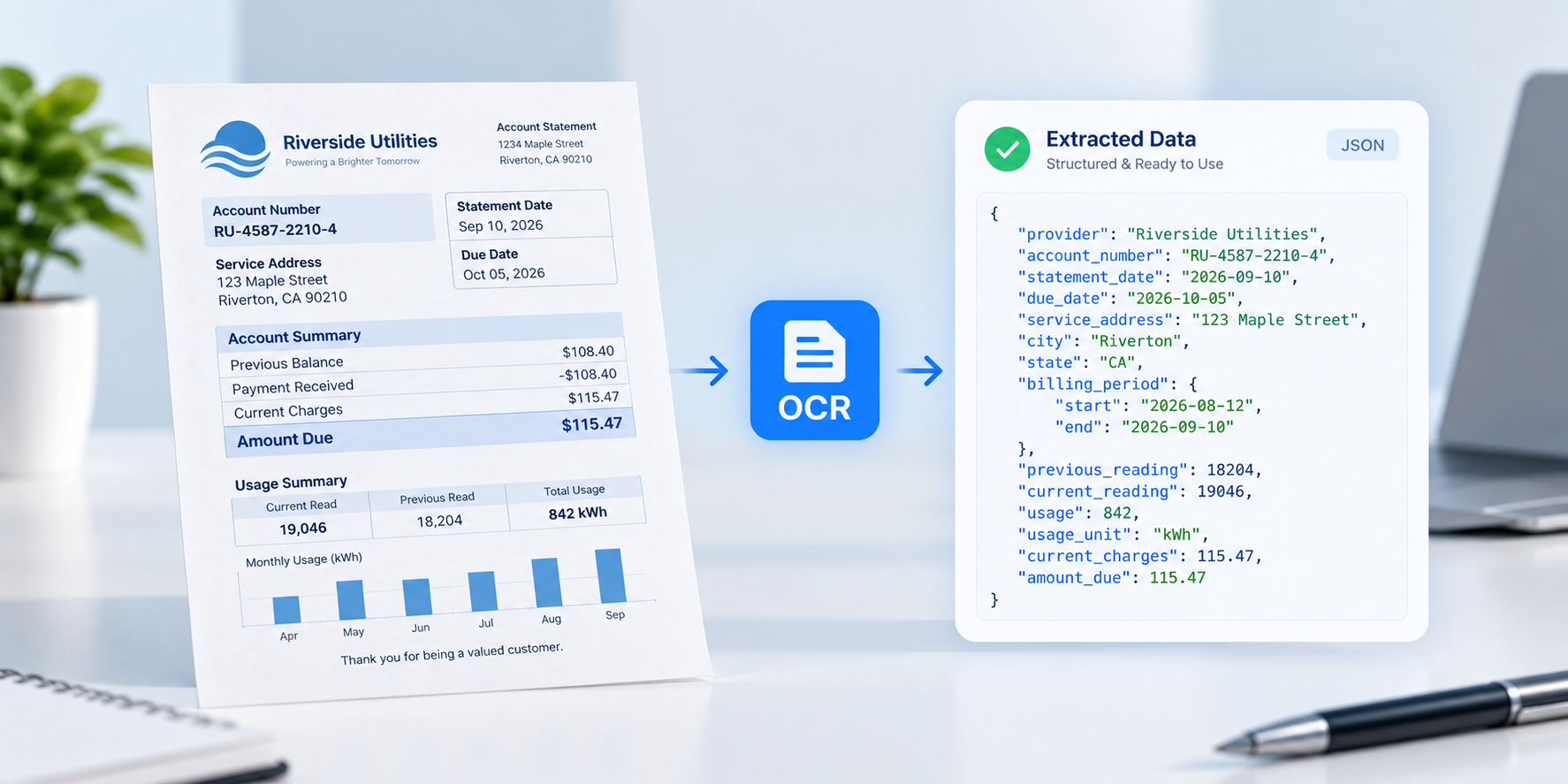
For a broader annotated statement showing the sections shared across different utility types, see our sample utility bill. For software QA and document extraction projects, our utility bill OCR testing guide covers ground truth, field validation and regression testing.
| Real Gas Bill | Fictional Educational Sample |
|---|---|
| Issued by an actual gas utility or supplier | Created for education/testing |
| Connected to a genuine customer account | No real account relationship |
| Uses real meter readings | Uses fictional meter readings |
| Uses actual heat-content/billing factors | Uses an illustrative factor |
| Uses actual tariff/service classification | Uses fictional service-class information |
| Can verify genuine service history | Cannot verify service |
Create a Sample Gas Bill
For legitimate software development, OCR testing, QA, training, classroom projects or UI mockups, use the sample gas bill generator .
Create a Fictional Natural Gas Bill Sample
For another fictional billing example, you can build a sample utility bill from the main site and choose the supported service type that best fits your testing, training or mockup project.
Enter fictional account details, gas usage and charge information for a legitimate testing, educational or demonstration project.
Generated samples are not official gas records and cannot verify address, identity, service, account ownership or payment.
Create a Sample Gas BillRelated Gas & Utility Bill Guides
Continue with the related guides below for gas meter readings, charges, billing calculations and terminology. Developers working with document extraction can also review Utility Bill OCR Testing.
Frequently Asked Questions About Sample Gas Bills
What does CCF mean on a gas bill?
CCF is a measure of natural-gas volume equal to 100 cubic feet.
What is a therm on a gas bill?
A therm is an energy unit equal to 100,000 British thermal units.
Is 1 CCF always equal to 1.037 therms?
No. The 1.037 factor on this page is an educational example. Actual gas heat content and provider billing factors can vary.
How is gas meter usage calculated?
A basic first step subtracts the previous meter reading from the current reading to determine the measured gas-volume difference.
What is a gas billing factor?
A billing factor is a provider-specific conversion used to translate measured gas volume into the energy quantity billed.
What is the difference between an actual and estimated gas reading?
An actual reading comes from a usable meter reading. An estimated reading is calculated when a usable actual reading is unavailable.
Can a customer submit a gas meter reading?
Some utilities permit customer-supplied readings under defined conditions. Availability and validation rules vary by provider.
What is a heating gas service class?
A heating classification generally means natural gas is used as a primary space-heating fuel. Utilities can apply different service or rate classes.
What are heating degree days?
Heating degree days are a weather-based measure used to compare heating conditions. Higher values generally indicate colder conditions and potentially greater heating demand.
Why does therms multiplied by my gas rate not equal my total bill?
The gas commodity rate can represent only one part of the bill. Delivery, customer charges, riders, taxes and previous account activity can also affect the total.
What is a Purchased Gas Adjustment?
Some utilities use a Purchased Gas Adjustment, gas-cost adjustment, fuel charge or similar mechanism to reflect changing natural-gas supply costs.
What is a baseline gas allowance?
Some utilities designate a baseline quantity of gas usage that can receive different pricing from usage above that level.
What is the difference between a gas supplier and local utility?
In some competitive markets, the supplier provides or prices the gas commodity, while the local utility operates the distribution system and delivers the gas.
Why are winter gas bills often higher?
Where natural gas is used for heating, colder weather and more heating degree days can substantially increase consumption.
Why should I compare therms per day?
Different billing periods can contain different numbers of days. Therms per day gives a more normalized consumption comparison.
What is effective gas bill cost per therm?
It is a blended educational calculation that divides total current gas charges by therms used. It is not necessarily the provider's official commodity rate.
Is budget billing the same as actual gas cost?
No. Budget billing can smooth monthly payments while actual gas charges continue to change with usage, rates and the provider's billing rules.
Can a fictional sample gas bill be used as proof of address?
No. A fictional sample is not issued or verified by a real gas utility and cannot verify residence, identity, service or account ownership.
Where can I create a fictional gas bill sample?
For legitimate testing, education and demonstration projects, use the sample gas bill generator .
Editorial Sources
This provider-neutral guide was cross-checked against public gas-billing education from U.S. energy and utility sources.
- U.S. Energy Information Administration: natural gas heat-content conversion
- U.S. Energy Information Administration: natural-gas measurement units
- Michigan Gas Utilities: Reading Your Energy Bill
- Columbia Gas of Ohio: Understanding Your Bill
- SoCalGas: How to Read My Bill
- Eversource: Gas Delivery Charges & Supply Costs
Actual gas heat content, meter units, billing factors, service classes, baseline allowances, rates, suppliers, riders, taxes and billing procedures vary by provider and jurisdiction.