
Home › Utility Bill Learning Center › How to Read a Gas Bill
To read a natural gas bill, follow this order: billing period → meter readings → read status → gas volume → conversion factor → therms → charges → amount due.
Start by confirming the meter number and whether the reading is actual or estimated. Then identify the measured gas volume, often shown in CCF or cubic feet, determine how the utility converts that volume into therms, and review the gas supply, delivery, customer, tax and account-summary charges.
Find These 8 Things First on a Gas Bill
If you are comparing these fields with a fictional statement for testing, education or a document mockup, the online utility bill generator provides a broader starting point across supported utility formats.
UtilityBillGenerator.net creates fictional sample gas bills only.
Samples are not issued, approved, authorized, certified or verified by actual gas utilities. They are intended for legitimate software testing, OCR development, UI/UX design, demonstrations, training and educational projects.
Annotated Fictional Gas Bill Example
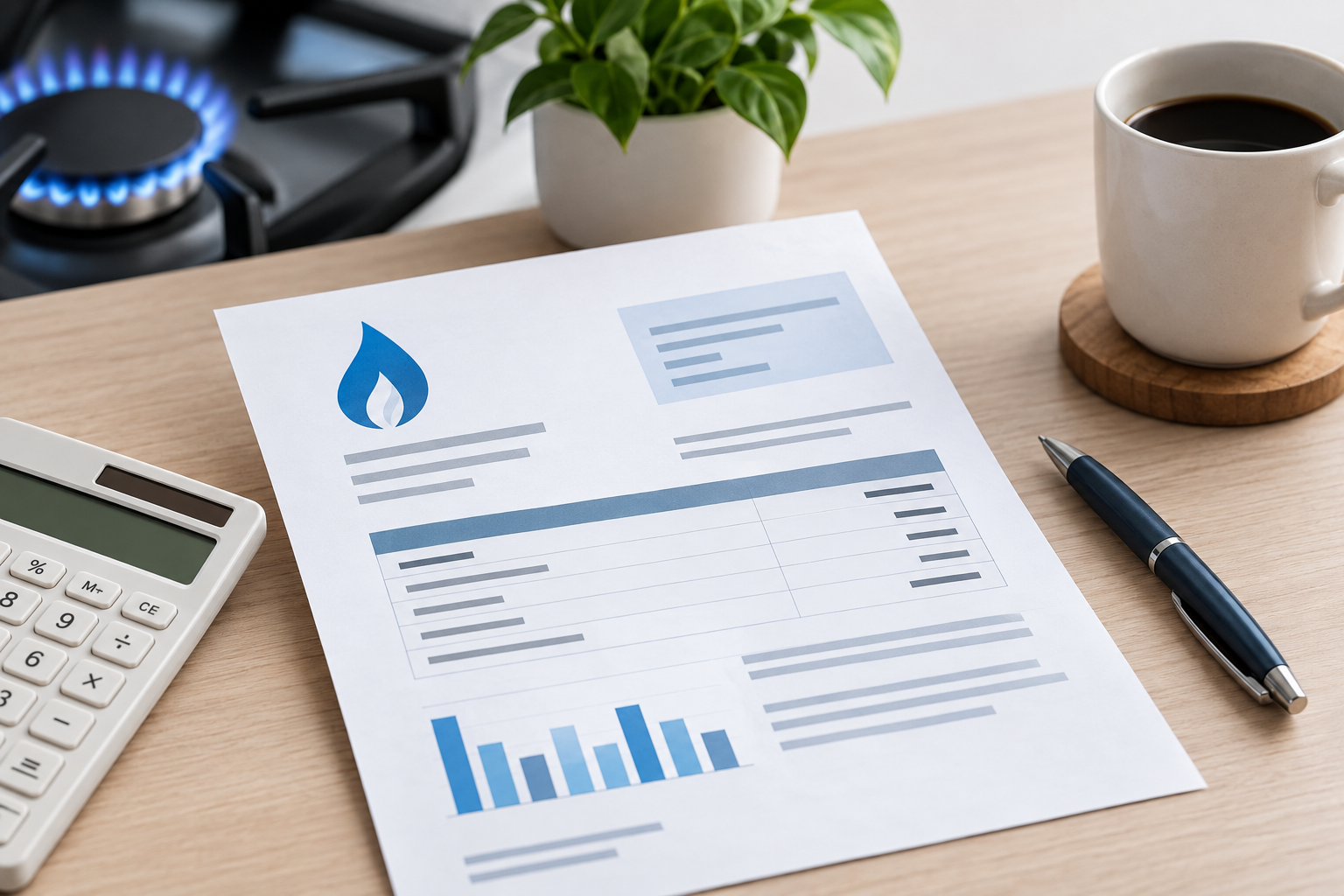
This fictional example shows how meter readings, CCF, a therm conversion factor and gas charges can connect on one statement.
| Gas Supply / Commodity | $54.73 |
| Delivery / Transportation | $67.95 |
| Customer / Service Charge | $13.50 |
| Taxes / Fees | $4.20 |
| Total Current Gas Charges | $140.38 |
91 CCF × 1.037 therms/CCF = 94.37 therms
The 1.037 therms-per-CCF factor above is an educational example. Do not reuse it for a real account unless it matches the actual utility's documented conversion for that billing period.
Gas Bill Math Checker
This tool compares meter-derived gas volume with reported CCF, converts that volume into therms using the entered provider factor, calculates average therms per day and estimates the effective current gas cost per therm.
This checker does not authenticate a gas statement, verify a meter, validate a provider factor or determine whether a tariff was applied correctly.
For detailed meter-reading concepts, see Utility Meter Readings Explained.
For balances, credits, payments and amount due, see Utility Bill Account Summary Explained .
1. Start With the Account Information
The first part of a gas bill usually identifies the account, service location, meter and applicable customer class.
| Field | What It Generally Identifies |
|---|---|
| Account number | The billing account. |
| Service address | The location receiving natural-gas service. |
| Meter number | The physical gas meter or associated meter record. |
| Rate class | The tariff or customer category used for billing. |
| Statement date | The date the statement was generated. |
2. Check the Billing Period and Billing Days
Gas usage can change sharply with weather, so billing-period length matters when comparing statements.
A 35-day winter bill can contain more therms than a 28-day bill even when daily gas use is similar.
3. Separate Current Gas Charges From Amount Due
The amount due should be read together with the due date, previous balance, payments and current charges. For a detailed explanation of how those account-level fields connect, see our utility bill account summary guide.
Current gas charges usually describe the newest billing period. Amount due can also include account activity from outside the current period.
That can include:
- previous balances;
- payments;
- credits;
- payment arrangements;
- budget billing adjustments.
4. Confirm the Gas Meter Number
Before doing any meter arithmetic, confirm that the statement's meter number matches the meter or meter record you are reviewing.
This is especially important when:
- the property has more than one meter;
- a meter was replaced;
- a building has multiple units;
- the account contains more than one service.
5. Find the Previous and Current Meter Readings
Current: 5,301
Difference: 91
The difference shows the change in measured gas volume before any provider-specific conversion is applied.
6. Check Whether the Gas Reading Is Actual or Estimated
| Reading Type | General Meaning |
|---|---|
| Actual | Based on meter data used for the billing cycle. |
| Estimated | Usage calculated because a final actual reading was unavailable or not used. |
| Remote / automatic | Meter information collected electronically. |
Estimated-to-actual example
Estimated: 5,280
Later actual: 5,301
A later actual meter reading can reconcile an earlier estimate, which may make the next bill look unusually high or low.
7. What Does CCF Mean on a Gas Bill?
CCF, or Ccf, means one hundred cubic feet of natural gas.
CCF measures physical gas volume.
The U.S. Energy Information Administration provides current definitions of common natural-gas units .
8. What Is a Therm on a Gas Bill?
A therm measures heat energy rather than physical volume.
Natural gas can have slightly different heat content, so the same physical gas volume does not necessarily represent exactly the same number of therms everywhere or at all times.
9. CCF vs Therm: What Is the Difference?
| Unit | Measures | Meaning |
|---|---|---|
| Cubic foot | Volume | Physical gas volume. |
| CCF | Volume | 100 cubic feet. |
| MCF | Volume | 1,000 cubic feet. |
| Btu | Energy | British thermal unit. |
| Therm | Energy | 100,000 Btu. |
CCF tells you how much gas volume was measured. Therms tell you how much heat energy that gas represents for billing.
10. Heat Factor vs Billing Factor: Are They the Same?
Not always. Utilities use different terminology and calculation methods.
Converts measured gas volume into heat-energy units such as therms.
A broader provider-specific factor that can incorporate one or more adjustments required by the utility's billing method.
Depending on the utility, considerations can include heat value, atmospheric pressure, delivery pressure, altitude, meter characteristics or other tariff-defined adjustments.
SoCalGas, for example, explains that its billing factor adjusts measured gas for characteristics such as delivery pressure, altitude and meter calibration.
See SoCalGas bill-reading guidance for one provider-specific example.
Use the actual factor and method shown or documented by the utility serving the account.
11. How to Calculate Gas Usage From Meter Readings
Step 1: Calculate the reading difference
Step 2: Convert the reading difference to gas volume
The provider's meter-reading method determines how the displayed reading converts to cubic feet or CCF.
Step 3: Convert volume to therms
EIA's current natural-gas conversion guidance explains why CCF and therms are related but not identical measures: CCF and therm conversion guidance .
12. What Is the Gas Supply or Commodity Charge?
The gas supply or commodity charge generally relates to the natural gas itself.
Depending on the jurisdiction, the gas commodity can come from the local utility or another permitted supplier.
13. What Is the Gas Delivery or Transportation Charge?
For a deeper explanation of commodity, supply, delivery, transportation, customer charges, taxes and other line items, see our gas bill charges explained guide.
Delivery or transportation charges generally relate to moving gas through transmission, pipeline and local distribution infrastructure to the service location.
14. What Is the Customer Charge on a Gas Bill?
A customer charge is often a fixed charge, meaning it can remain on the bill even when gas usage is very low. It is separate from usage-based therm or CCF charges and may cover account, meter or distribution-system costs.
A customer or basic-service charge is generally not based directly on the number of therms consumed.
Depending on the utility, it may be structured as:
- a fixed monthly amount;
- a daily service charge;
- another tariff-defined recurring charge.
15. What Are Baseline, Tiered or Seasonal Gas Rates?
Gas providers may use different abbreviations for billing factors, rate classes, riders and adjustments. Our utility bill terms and abbreviations guide can help decode unfamiliar labels.
Some utilities use rate structures where the price per therm changes according to usage, season or an allowed baseline quantity.
Additional Usage → Another Applicable Rate
16. Weather Matters When Comparing Gas Bills
Natural-gas usage can change dramatically with outdoor temperature when gas is used for space heating.
| Period | Therms | Days | Therms / Day | Average Temperature |
|---|---|---|---|---|
| January | 120 | 30 | 4.00 | 29°F |
| February | 105 | 28 | 3.75 | 35°F |
February used fewer therms per day, but it was also warmer. That means part of the reduction may be explained by lower heating demand rather than an efficiency improvement.
What are heating degree days?
Heating degree days are a weather indicator used to approximate how much heating demand outdoor temperatures create. A colder period generally produces more heating degree days.
Some gas utilities include average temperature or heating-degree-day comparisons in their usage-history sections.
Compare therms per day, similar weather periods and, when possible, the same month from the previous year.
17. Why Is My Gas Bill So High?
Start by checking whether therm usage increased.
- Colder weather
- Higher heating demand
- Thermostat changes
- More hot-water use
- More occupants
- Longer billing period
- Estimated-to-actual correction
- Commodity rate changed
- Delivery rate changed
- Customer charge changed
- Tariff adjustment
- Taxes or fees changed
- Credit expired
- Previous balance added
18. What to Do If Your Gas Bill Does Not Add Up
If the numbers still do not reconcile, compare the statement with our utility bill calculation guide to understand how usage, rates, fixed charges, taxes and adjustments combine into the final bill.
- Confirm the billing period.
- Confirm the gas meter number.
- Check previous and current readings.
- Check whether the reading is actual or estimated.
- Identify the unit shown by the meter.
- Confirm how the utility converts the meter reading to CCF.
- Find the provider's therm or billing factor.
- Recalculate reported therms.
- Identify the exact disputed charge.
- Check the applicable tariff or rate class.
- Contact the gas utility for its calculation.
- Keep the case or reference number.
- Use the applicable regulator or consumer complaint process if the issue remains unresolved.
It creates fictional sample utility bills only and does not authenticate utility-issued statements, meter records, gas usage or account balances.
How Sample Gas Bills Can Be Used
For a full fictional example showing these sections together, review our annotated sample gas bill. You can also compare it with a provider-neutral sample utility bill. For software and QA teams extracting meter readings, dates, usage, charges and account fields, see our utility bill OCR testing guide.
A fictional sample gas bill can demonstrate:
- sample account information;
- meter numbers;
- service periods;
- meter readings;
- CCF usage;
- conversion factors;
- therms;
- fictional supply and delivery charges;
- sample current-charge totals.
Appropriate uses include:
- software testing;
- OCR testing;
- document extraction;
- UI/UX prototypes;
- training;
- education;
- demonstrations.
Any provider name, account number, meter number, reading, therm value, rate, charge or balance used in a UtilityBillGenerator.net sample is fictional sample information.
Frequently Asked Questions
Start with the billing period, meter number and readings. Then check whether the reading is actual or estimated, identify gas volume, review the provider's conversion or billing factor, confirm therm usage, and then review supply, delivery, customer charges and amount due.
CCF means 100 cubic feet of natural gas. It measures physical gas volume.
A therm is a heat-energy unit equal to 100,000 Btu.
No. The exact relationship depends on the heat content of the gas and the utility's applicable conversion or billing method.
A heat or therm-conversion factor relates measured gas volume to energy content. A billing factor can be a broader utility-specific adjustment that may incorporate heat value, pressure, altitude, meter characteristics or other billing conditions.
A utility may estimate usage when a final actual meter reading is unavailable or not used. A later actual reading can result in a correction.
Homes using gas for space heating typically consume more therms during colder weather. Compare therms, therms per day, billing days and similar weather periods.
Heating degree days are a weather indicator used to approximate heating demand. More heating degree days generally indicate colder conditions and potentially greater space-heating needs.
No. UtilityBillGenerator.net creates fictional sample gas bills only. Samples are not issued, authorized, certified or verified by actual gas utilities.
Create a Sample Gas Bill
For a broader multi-utility workflow before choosing the dedicated gas template, you can create a custom utility bill sample online from the main site.
UtilityBillGenerator.net lets you create customizable sample gas bills using fictional information for legitimate software testing, OCR development, UI/UX mockups, demonstrations, training and educational projects.
Samples are not issued, approved, authorized, certified or verified by actual gas utilities.
Create a Sample Gas BillOfficial Sources & Methodology
Natural-gas units, meter conversions, heat content, therm calculations, customer charges and rate structures vary by utility. Technical concepts in this guide were cross-checked against current government and utility resources.
- U.S. Energy Information Administration - Natural Gas Units of Measure
- U.S. Energy Information Administration - Natural Gas Heat Content and CCF/Therm Conversion
- Massachusetts Department of Public Utilities - Understanding Your Gas Bill
- Peoples Gas - Reading Your Bill
- SoCalGas - How to Read My Bill
All Crestline Gas names, meter numbers, readings, factors, rates, dates and dollar amounts shown on this page are fictional educational examples.