
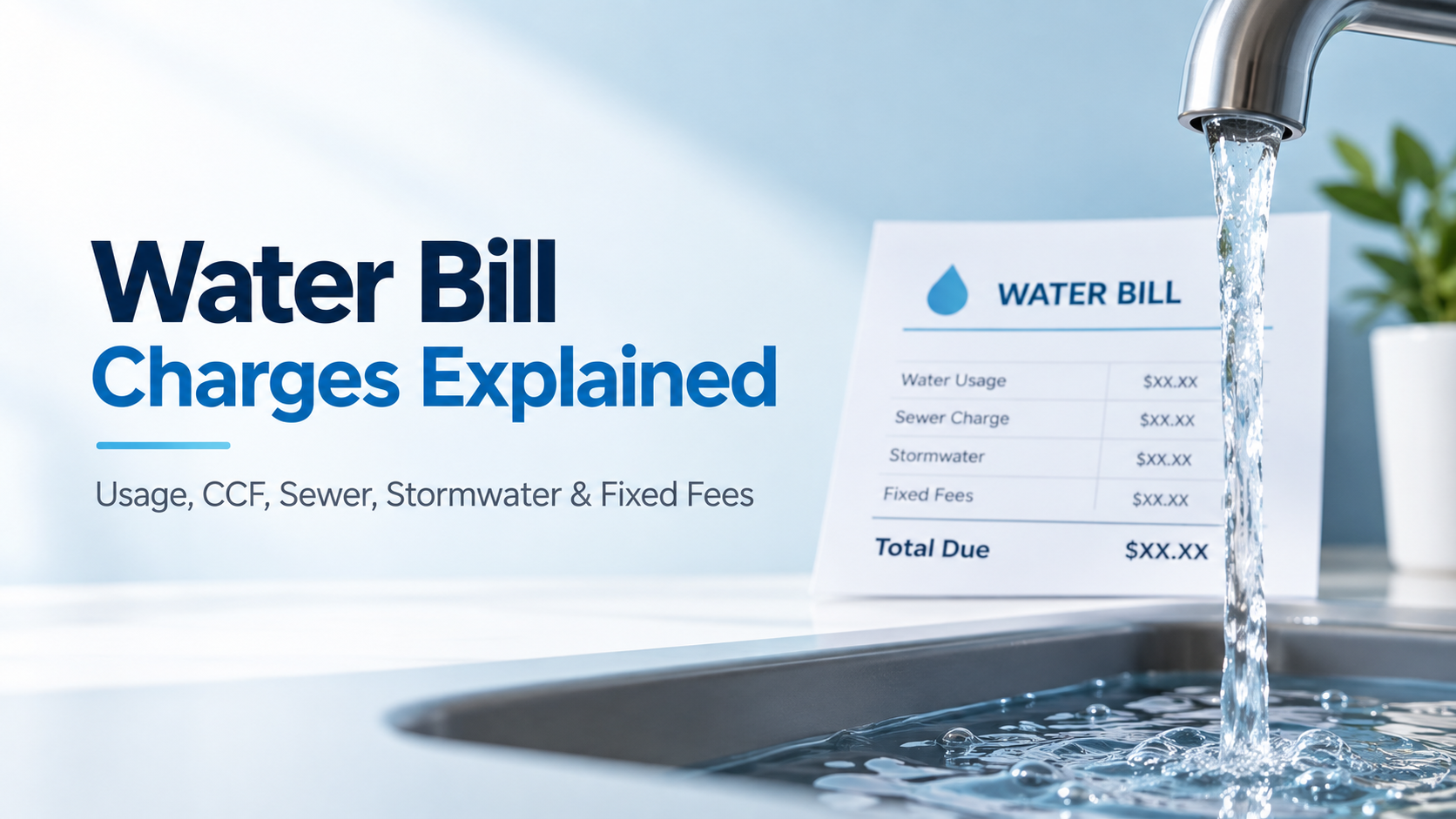
A water bill is not always calculated by multiplying water consumption by one rate. Depending on the utility, the final charge can include a minimum bill, fixed base fee, included usage allowance, tiered water rates, seasonal pricing, sewer minimums, winter averages, stormwater, infrastructure surcharges, taxes, credits and charges collected for another agency.
The fastest way to understand the total is to first identify the billing model, then reconstruct each component separately. This guide shows how to do that and includes tools for calculating, comparing and reconciling water-related charges.
However, the actual formula can change if the utility uses a minimum bill, included allowance, tiered pricing, seasonal rates, winter-average sewer billing, stormwater property charges or other provider-specific rules.
Water Bill Charges in 30 Seconds
Step 1: Identify Your Water Billing Model
Before multiplying anything, determine which type of billing structure your utility actually uses.
The Basic Water Bill Formula
A useful general framework is:
A previous balance can then affect the account amount due:
Base Charge vs Minimum Bill vs Included Usage
These terms can look similar but they do not always mean the same thing.
| Billing Structure | What It Usually Means |
|---|---|
| Base Charge | A fixed amount, with consumption normally billed separately. |
| Minimum Bill | The account pays at least a specified minimum amount. |
| Included Usage | The fixed or minimum payment includes a certain quantity of water. |
| Minimum Billable Volume | At least a specified volume is charged even if actual use is lower. |
Fictional included-usage example
Suppose a fictional minimum bill is $20 and includes the first 2 CCF. The variable rate above that allowance is $4 per CCF.
At 1 CCF of usage:
At 5 CCF:
CCF, Gallons and Other Water Billing Units
One CCF, also called HCF, equals 100 cubic feet of water or approximately 748 U.S. gallons.
| Unit | Meaning |
|---|---|
| CCF / HCF | 100 cubic feet, approximately 748 gallons |
| kgal | 1,000 gallons |
| ft³ | Cubic feet |
| m³ | 1,000 litres |
| kL | 1,000 litres |
How Does a Uniform Water Rate Work?
With a uniform rate, the same per-unit rate applies to the applicable metered consumption.
Fictional example
Usage: 8 CCF
Rate: $5.25 per CCF
If the fixed base charge is $18:
How Do Tiered Water Rates Work?
An increasing-block structure applies progressively higher rates to successive portions of consumption.
| Fictional Tier | Usage | Rate |
|---|---|---|
| Tier 1 | First 4 CCF | $4.00 / CCF |
| Tier 2 | Next 4 CCF | $5.50 / CCF |
| Tier 3 | Above 8 CCF | $7.00 / CCF |
At 10 CCF:
Why Can the Same Water Usage Cost More in Summer?
Some utilities use seasonal pricing. The amount of water can stay exactly the same while the price changes.
Fictional example
| Period | Usage | Rate | Usage Charge |
|---|---|---|---|
| Winter | 8 CCF | $4.50 | $36.00 |
| Summer | 8 CCF | $6.25 | $50.00 |
The household used the same amount of water, but the variable charge rose by $14 because the seasonal rate changed.
Why Can Two Customers With the Same Usage Pay Different Amounts?
Usage alone does not determine every water bill.
Two customers can have different charges because of:
- different rate zones
- inside-city versus outside-city service
- meter size
- customer class
- residential versus commercial service
- seasonal pricing
- different sewer methods
- different stormwater classifications
Meter-size charges
Some utilities increase fixed service charges as meter capacity increases.
How Is Sewer Calculated on a Water Bill?
Most properties do not have a separate residential meter measuring the wastewater leaving the property.
Utilities can therefore use incoming water consumption as an input when calculating wastewater charges.
However, billable sewer volume can be based on:
- current actual water usage
- winter-average usage
- the lower of current use and winter average
- a minimum billable volume
- a maximum cap
- a utility-defined percentage of water usage
- approved usage after irrigation deductions
What Is Winter-Average Sewer Billing?
Some utilities use lower-irrigation winter consumption to estimate the amount of water that normally enters the wastewater system.
Simple winter-average model
Lower-of model
Some systems can use the lower of current summer consumption and the established winter average.
| Scenario | Winter Average | Current Water | Possible Sewer Basis |
|---|---|---|---|
| A | 6 CCF | 4 CCF | 4 CCF |
| B | 6 CCF | 10 CCF | 6 CCF |
Sewer Minimums and Sewer Caps
Minimum Sewer Volume
Some utilities bill at least a minimum amount of wastewater volume even when actual consumption is lower.
Sewer Cap
Some residential programs limit the maximum water volume used for certain sewer calculations.
Fictional sewer-cap example
Water use: 15 CCF
Sewer cap: 10 CCF
The customer's water charge can still be based on all 15 CCF.
Does Irrigation Water Count Toward Sewer?
Not always.
Some utilities recognize a separate irrigation meter or approved submeter because irrigation water generally does not return to the sanitary sewer.
Fictional example
Main meter: 12 CCF
Approved irrigation: 4 CCF
Can a Leak Affect Sewer Charges?
Yes, depending on the billing system.
A leak can potentially affect:
| Bill Component | Possible Effect |
|---|---|
| Water usage | Consumption can rise sharply. |
| Tiered pricing | Usage may enter a more expensive tier. |
| Current sewer | Can increase if sewer follows current water use. |
| Future sewer | A leak during the averaging period could affect a future winter average. |
| Adjustment | Some utilities have qualifying leak-adjustment procedures. |
For consumption and meter diagnostics, see How to Read a Water Bill .
How Is a Stormwater Charge Calculated?
Stormwater billing is fundamentally different from ordinary water usage because rain runoff is often related to the property rather than the amount of tap water consumed.
| Stormwater Model | Possible Calculation Basis |
|---|---|
| Residential Flat Fee | Standard monthly residential amount. |
| ERU | Equivalent Residential Units based on impervious area. |
| Impervious Area | Roof, pavement, driveway and similar surfaces. |
| Gross + Impervious Area | Combination of parcel size and hard-surface area. |
| Property Classification | Residential, non-residential, condominium or another class. |
Generic ERU example
Can a Stormwater Fee Be Reduced or Appealed?
Some stormwater programs provide credits, adjustments or appeals.
Possible credit situations
- approved runoff-management practices
- impervious-area reduction
- green infrastructure
- qualifying direct discharge
- other local credit programs
Possible appeal issues
- wrong parcel
- wrong property classification
- incorrect gross area
- incorrect impervious area
- incorrect allocation between multiple accounts
Water Bill Riders and Surcharges
Not every surcharge is calculated the same way.
| Surcharge Type | Generic Calculation |
|---|---|
| Flat Rider | $4.00 per month |
| Usage Rider | CCF × rider rate |
| Percentage Surcharge | Applicable subtotal × percentage |
Why Is Another Agency's Charge on My Water Bill?
The utility sending the statement may collect certain charges for another public agency or regional service provider.
Examples can include:
- regional wastewater treatment
- stormwater services
- municipal programs
- other locally authorized utility-related services
This can explain why reconstructing only water usage plus sewer does not match the complete statement.
How Are Apartment Water Bills Calculated?
There is no single nationwide apartment water-billing formula.
Common arrangements include:
Direct Meter
The utility meters and bills the unit directly.
Submeter
A property has a master utility account but measures individual-unit consumption separately.
Allocation / RUBS
A master utility cost may be allocated using disclosed factors such as occupancy, unit size or another permitted method.
Included in Rent
The property owner may include water service within another housing charge.
How Is a Water Bill Calculated Without an Individual Meter?
An unmetered or non-individually-metered account can use a different structure from a standard metered bill.
Possible methods include:
- flat rate
- assessed charge
- master-meter allocation
- occupancy-based allocation
- unit-size allocation
- fixed service charge
How Are Partial-Month Water Bills Calculated?
When checking a prorated or partial-month statement, compare the billing days with the normal billing cycle as well as the service dates used in the calculation. After the current charges, credits and previous balance are combined, confirm the due date shown on the statement so the charge calculation is not confused with the payment deadline.
When service begins or ends during a billing cycle, some utilities may prorate certain fixed charges, allowances or billing components.
Possible variables include:
- days of service
- included usage allowance
- fixed monthly charge
- rate-effective date
- customer class
Did the Rate Change During the Billing Period?
A bill can increase even when consumption remains stable because a new rate schedule took effect.
When comparing two statements, check:
- rate effective date
- old volume rate
- new volume rate
- fixed-charge changes
- sewer-rate changes
- stormwater-rate changes
- new riders or surcharges
If a rate changed during the billing period, follow the provider's method for applying or prorating the new rate.
Why Does My Water Bill Math Not Match the Actual Bill?
This is one of the most important troubleshooting questions.
Even if your basic usage math is correct, one of these mechanisms may explain the difference:
| Possible Reason | What to Check |
|---|---|
| Minimum bill | Does the account have a minimum monthly charge? |
| Included usage | Does the fixed charge include some CCF or gallons? |
| Tiered rates | Did part of the usage enter another block? |
| Seasonal pricing | Did the applicable rate period change? |
| Meter size | Does meter capacity affect the fixed charge? |
| Rate zone | Are you using the correct service-area rate? |
| Sewer winter average | Is sewer based on earlier winter usage? |
| Sewer minimum | Is a minimum wastewater volume charged? |
| Sewer cap | Is wastewater volume limited? |
| Irrigation exclusion | Is approved non-sewer use deducted? |
| Stormwater | Is the fee based on property data rather than CCF? |
| Rider | Is there a flat, volumetric or percentage surcharge? |
| Pass-through charge | Is another authority billed on the statement? |
| Estimated-reading correction | Was an earlier estimate reconciled? |
| Rate change | Did new rates take effect? |
| Previous balance | Are old account charges mixed with current charges? |
Fictional Water, Sewer and Stormwater Charge Example
If you want to compare these charge calculations with the structure of a complete statement, see what a utility bill looks like and our annotated sample utility bill. These guides show where usage, balances, itemized charges and payment information commonly appear.
This example is completely fictional. It demonstrates how multiple charge mechanisms can combine.
Crestline Water Services
Water Bill Reconstruction Calculator
For fictional statement testing beyond the calculation examples in this guide, the online utility bill generator can be used to create and review a customizable sample bill layout.
Use this educational tool to reconstruct a multi-component water bill. It includes minimum bills, included water, multiple sewer methods, stormwater models and surcharge fields.
Reconstruct Current Water-Related Charges
Use your provider's actual rates and rules. The prefilled values are fictional examples.
Tiered Water Rate Calculator
Use this tool when your utility bills different consumption blocks at different prices.
Calculate an Increasing-Block Water Charge
Compare Two Water Bills and Find What Changed
A total-bill comparison is useful, but a component-by-component comparison is much better.
Two-Bill Charge Diagnostic
Calculate Effective Water-Bill Cost
The advertised water-rate number is often only one piece of the complete bill.
The reconstruction calculator above calculates both metrics automatically.
25-Point Water Bill Charge Audit
For automated document-processing tests, our utility bill OCR testing guide covers extraction and validation of fields such as account details, meter readings, usage, dates, charges and totals.
- Identify the customer rate class.
- Identify the service area or rate zone.
- Confirm meter size where it affects the fixed fee.
- Identify the water usage unit.
- Convert CCF and gallons correctly.
- Check whether a minimum bill applies.
- Check whether the minimum includes usage.
- Identify the billable usage above the allowance.
- Determine whether the water rate is uniform or tiered.
- Calculate each tier separately.
- Check for seasonal pricing.
- Check the current rate-effective date.
- Identify the sewer billing method.
- Check the winter average.
- Check for a sewer minimum.
- Check for a sewer cap.
- Verify approved irrigation or non-sewer deductions.
- Identify the sewer rate and sewer fixed charge.
- Identify the stormwater model.
- Review stormwater property data if applicable.
- Check for stormwater credits or appeal options.
- Review riders and percentage surcharges.
- Identify pass-through or regional charges.
- Separate previous balances from current charges.
- Reconcile your calculated current charges against the bill.
Frequently Asked Questions
How is a water bill calculated?
A water bill can combine fixed service charges, consumption charges, sewer or wastewater, stormwater, surcharges, taxes and credits. The exact formula depends on the utility and rate structure.
What is a minimum charge on a water bill?
A minimum charge is the lowest amount an account may be billed under the applicable rate structure. It may or may not include some water usage.
What is included usage?
Included usage means a fixed or minimum charge includes a specified quantity of water before additional volume charges begin.
What is a base charge?
A base charge is generally a fixed recurring service component. Unlike an included-usage minimum, the base charge does not necessarily include any water consumption.
What does CCF mean on a water bill?
CCF means 100 cubic feet of water. One CCF is approximately 748 gallons.
How do tiered water rates work?
Different blocks of consumption are priced separately. Under an increasing-block structure, higher usage blocks have higher per-unit prices.
Why did my water bill increase with the same usage?
The rate, seasonal period, fixed charge, sewer rate, stormwater fee, rider or another billing component may have changed even though consumption stayed the same.
How is sewer calculated on a water bill?
Sewer can be based on current water usage, winter-average consumption, the lower of two usage values, a minimum, a capped amount or another provider-specific methodology.
Why is my sewer charge higher than my water charge?
Water and wastewater systems have different infrastructure, treatment, rates and fixed charges. A higher sewer charge does not automatically indicate an error.
What is winter-average sewer billing?
Some utilities use water consumption during lower-irrigation winter months to estimate later wastewater billing because winter usage can better represent indoor water entering the sewer system.
What is a sewer cap?
A sewer cap limits the maximum water volume used for certain wastewater billing calculations.
Does irrigation water count toward sewer?
It depends on the provider. Some utilities recognize approved separate irrigation meters or submeters and exclude that volume from sewer billing.
How is a stormwater fee calculated?
Stormwater can be billed as a flat residential fee or based on impervious area, equivalent residential units, gross property area, property class or another local methodology.
Can I appeal a stormwater charge?
Some jurisdictions offer appeals when parcel data, property classification, gross area, impervious area or account allocation is incorrect. Follow the local stormwater program's process.
Can stormwater fees be reduced?
Some programs offer credits for qualifying runoff-management practices, impervious-area reductions or other approved measures. Eligibility varies by jurisdiction.
What is a water bill surcharge?
A surcharge is an additional charge that can be flat, usage-based or percentage-based. The utility should identify what the surcharge applies to.
How are apartment water bills calculated?
Apartments can be directly metered, individually submetered or billed through an allocation method such as a ratio utility billing system. Rules vary by property and jurisdiction.
How is a water bill calculated without an individual meter?
An unmetered account may use a flat fee, assessed charge, master-meter allocation or another non-consumption method.
Why does my calculated total not match the bill?
Check for minimum charges, included usage, tiered rates, seasonal pricing, sewer averages, sewer caps, stormwater, riders, pass-through charges, rate changes, account adjustments and previous balances.
Does UtilityBillGenerator.net issue official water bills?
No. UtilityBillGenerator.net provides fictional sample utility documents only. They are not issued, approved, authorized, certified or verified by utilities.
Create a Sample Utility Bill
UtilityBillGenerator.net creates fictional sample utility bills for legitimate software development, QA, OCR testing, UI/UX mockups, training, demonstrations and educational projects.
Sample documents are not issued, approved, authorized, certified or verified by actual utility providers and are not proof of address, identity, account ownership, service or payment.
Create a Sample Utility BillEditorial Sources & Verification
- U.S. EPA WaterSense for CCF conversion, fixed and variable fees, uniform rates, increasing and declining blocks, seasonal rates, drought rates and water-budget pricing.
- Charleston Water System for a real-world example of a minimum bill that includes initial CCF before additional volume charges.
- EPA WaterSense at Work for wastewater calculations and possible non-sewer water deductions.
- Philadelphia Water Department for residential and property-based stormwater calculation methods, credits and appeals.
- Cobb County Water System for an ERU-based impervious-area stormwater calculation example and stormwater-credit program.
Rates, allowances, minimums, tiers, sewer methods, stormwater formulas, apartment billing rules, riders and account adjustments vary by provider and jurisdiction. Use the utility's current tariff and billing documentation when checking an actual account.
Disclaimer: This page provides general educational information about water, sewer and stormwater billing. The formulas and examples do not reproduce a specific utility tariff. UtilityBillGenerator.net provides fictional sample utility documents only and does not issue, authorize, certify or verify actual utility bills.