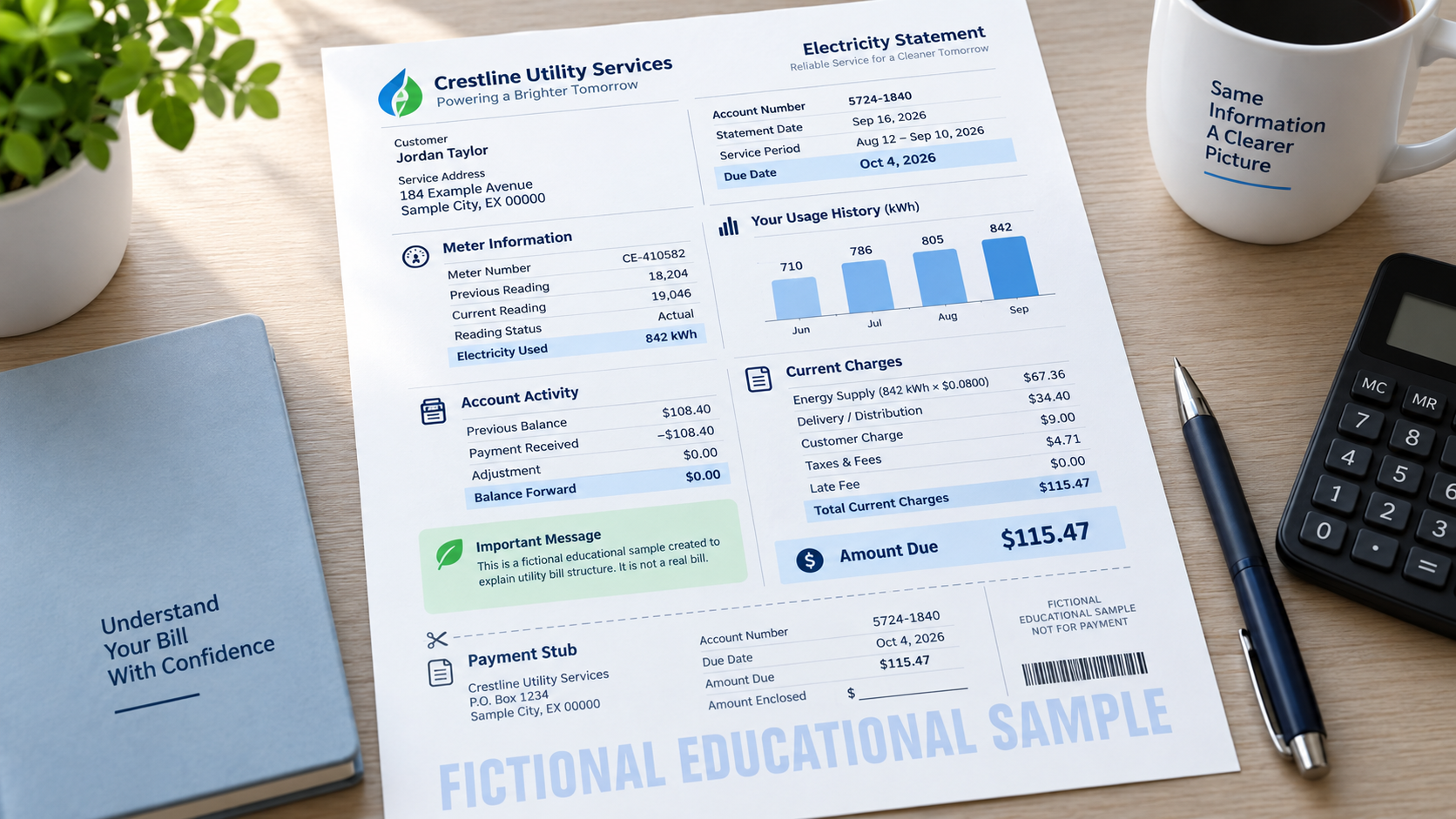

Fictional sample utility bills can be useful when a project needs realistic billing fields and document structure without using a real customer statement. Developers, QA teams, designers, educators and document-processing teams may need sample electricity, gas, water, internet or mobile bills for software testing, OCR evaluation, UI/UX mockups, demonstrations, training and other controlled development workflows.
The important distinction is that a sample document is created for testing or educational purposes. It is not an official utility bill, is not issued by a real provider and should not be represented as proof of address, identity, account ownership, service or payment.
What Is a Fictional Sample Utility Bill?
A fictional sample utility bill is a test document that imitates the general structure and fields commonly found on utility statements without representing an actual customer account.
A sample can include fields such as:
- fictional provider name
- customer or account name
- sample account number
- service address
- billing period
- bill date and due date
- previous balance
- payments and credits
- usage or consumption
- meter readings
- rates and line-item charges
- taxes and fees
- current charges
- amount due
If you are defining the structure of a test document first, review what a utility bill looks like and our guide explaining what a utility bill is.
Why Do Software Teams Use Sample Utility Bills?
Testing with real customer documents can introduce unnecessary privacy, security and data-handling concerns. Synthetic or fictional samples give development teams more control over the values, layouts and edge cases included in a test set.
A controlled test document can be changed repeatedly without altering a real account. Teams can create unusual balances, different billing periods, long account numbers, multiple charges, credits, missing fields or other test conditions that may be difficult to collect from production documents.
1. Software Testing and Quality Assurance
Software testing is one of the most practical uses for fictional utility bill samples. A QA team may need to confirm that an application correctly uploads, displays, stores, converts or extracts information from a billing document.
Example QA checks can include:
- PDF upload and preview behavior
- image upload handling
- document-page rendering
- field detection
- currency formatting
- date parsing
- responsive document previews
- download and export workflows
- multi-page document handling
- error and missing-field states
Because the sample data is fictional, the same document can be shared across developers, testers and staging environments without exposing an actual customer's utility information.
2. OCR and Document Data Extraction Testing
Optical character recognition and document-AI systems need varied test documents before extraction quality can be evaluated reliably. Utility bills are useful OCR test cases because they combine headings, tables, dates, addresses, identifiers, decimal values, charges and sometimes meter information on the same document.
A test workflow might check whether an OCR system correctly extracts:
- provider name
- customer name
- account number
- service address
- billing period
- due date
- usage values
- meter readings
- individual charges
- taxes and fees
- amount due
Our utility bill OCR testing guide covers ground truth, field mapping, validation rules, OCR accuracy, synthetic datasets, regression testing and common extraction failure modes in greater detail.
3. UI and UX Mockups
Designers may need believable billing content when creating account dashboards, payment screens, statement viewers, customer portals or mobile applications. Using only placeholder text such as “Lorem ipsum” does not reveal how a real interface behaves when dates, addresses, account identifiers and monetary values have different lengths.
A fictional sample allows the UI team to test:
- long provider and customer names
- long or formatted account numbers
- different service-address lengths
- large and small monetary values
- negative credits
- multiple line items
- responsive table behavior
- desktop and mobile layouts
- PDF and image previews
4. Product Prototypes and Demonstrations
A prototype often needs realistic sample content before production data exists. Fictional utility documents can support demonstrations for document-management systems, billing dashboards, OCR products, accounting workflows and customer-support tools.
The sample should remain clearly fictional so viewers understand that the demonstration is showing product behavior rather than an actual customer account.
5. Employee Training and Internal Documentation
Training material often works better when employees can see complete examples rather than isolated field names. A fictional bill can be annotated to explain where information normally appears and how different fields relate to one another.
For example, training may explain the difference between current charges and the total account balance. Our utility bill account summary guide explains previous balances, payments, credits, billing periods, account numbers and amount-due fields.
6. Educational Projects
Fictional bills can also be used in classroom exercises and educational demonstrations about household expenses, utility consumption, billing terminology and document structure.
For terminology, see the utility bill terms and abbreviations glossary. For the mathematical side of statements, see how utility bills are calculated.
7. Test Data for Document Processing Systems
Document-processing systems usually need more than one perfect sample. A useful test dataset contains multiple fictional bills with controlled differences.
A QA dataset might vary:
- document type
- provider-style layout
- billing period length
- account-number format
- date format
- currency amounts
- number of line items
- page count
- image quality
- optional and missing fields
This makes it possible to define expected output and compare software results against known test data.
What Information Should a Sample Utility Bill Contain?
The fields should match the purpose of the test. An OCR project may need precise field coverage, while a UI mockup may care more about document length and layout.
Common field groups include:
Account Information
- fictional customer name
- sample account number
- service address
- mailing address
Billing Information
- billing period
- bill date
- due date
- previous balance
- payments
- credits
- current charges
- amount due
Service Information
- utility or service type
- usage quantity
- usage unit
- meter number where applicable
- previous and current meter readings
- rate or pricing information
Choose the Right Sample for the Test
Different utility types produce different testing requirements. A strong dataset should use the document type that matches the system being evaluated.
Electricity Bill Samples
Electricity test documents may include meter readings, kWh usage, energy charges, delivery charges, taxes and account balances. See our sample electricity bill example for an annotated reference.
Gas Bill Samples
Gas statements may include therms, CCF or MCF, meter readings, delivery charges and gas-service fees. Review the sample gas bill example for common fields.
Internet and Mobile Bill Samples
Telecom-style bills focus more heavily on monthly plans, equipment, discounts, line charges, device payments, data and fees. See our sample internet and phone bill examples.
General Utility Bill Samples
For a broader example covering common account and billing fields, start with the sample utility bill explained guide.
How to Create Better Test Cases
A useful test set should contain predictable differences instead of randomly changing every field at once.
For example, create separate cases for:
- a normal current balance
- a previous balance plus new charges
- a payment or credit
- a long billing period
- a short billing period
- a large usage value
- a zero-usage case
- multiple line items
- multiple pages
- optional fields being absent
Changing one condition at a time makes software failures easier to diagnose.
Why Synthetic Test Data Can Be Better Than Real Customer Bills
A real statement can contain names, addresses, account identifiers, payment information or other customer data that a test environment does not need. Synthetic samples reduce that dependency while giving teams complete control over the expected values.
They also make regression testing easier because the input and expected output can remain fixed between software releases.
Use Fictional Data Consistently
A useful sample should clearly look like test data when used outside a private development workflow. Fictional provider names, obviously synthetic account identifiers and clear sample markings help prevent the document from being confused with an actual provider-issued statement.
UtilityBillGenerator.net produces fictional sample documents for legitimate development, QA, OCR testing, mockups, training, demonstrations and educational work. Generated documents are not issued, approved, authorized, certified or verified by actual utility providers.
Create Fictional Utility Bill Samples for Testing
If your project needs customizable test inputs, the online utility bill generator can be used to create fictional utility bill samples with controlled fields and values.
You can also use the service-specific test tools when a project needs a particular document structure:
- electricity and general utility bill generator
- gas bill generator
- internet and mobile bill generator
- Spectrum-style bill generator
For additional controlled QA cases, you can create fictional utility bill samples online and change account details, billing periods, usage, charges and other test fields between cases.
Related Utility Bill Testing and Reference Guides
These guides can help define fields and expected values before a sample document is added to a test dataset:
- Utility Bill OCR Testing
- Sample Utility Bill Explained
- What Does a Utility Bill Look Like?
- What Is a Utility Bill?
- Utility Bill Account Summary Explained
- Utility Bill Terms & Abbreviations
- How Are Utility Bills Calculated?
Frequently Asked Questions
Why use a fictional utility bill instead of a real customer bill?
A fictional document gives a team control over the test values while avoiding unnecessary use of real customer information. It can also be reused consistently for regression testing.
Can sample utility bills be used for OCR testing?
Yes. Fictional bills can be paired with known ground-truth values to measure whether OCR and document-extraction systems identify the correct fields. See the utility bill OCR testing guide for a complete QA workflow.
Can developers use sample utility bills for software testing?
Yes. They can be used to test uploads, document previews, field extraction, parsing, data validation, exports, responsive layouts and other development or QA workflows.
Can designers use them for UI or UX mockups?
Yes. Fictional sample values are useful when testing how realistic billing information fits into dashboards, statement viewers, payment screens and mobile interfaces.
Can sample utility bills be used for employee training?
Yes. A fictional sample can demonstrate statement fields and workflows without exposing a real customer's account information.
Are documents created by UtilityBillGenerator.net official utility bills?
No. They are fictional sample documents. They are not issued, approved, authorized, certified or verified by real utility providers and should not be represented as provider-issued records.
Can a fictional sample utility bill be used as proof of address?
No. A fictional sample is not proof of address, identity, account ownership, service or payment. It is intended for legitimate testing, training, demonstration, educational and development purposes.
Final Takeaway
The main value of a fictional utility bill is controlled testing. Instead of depending on real customer statements, teams can build repeatable sample documents for software QA, OCR evaluation, document extraction, UI/UX design, prototypes, demonstrations, training and education.
Start with a clear test objective, use fictional data consistently, define the expected result and keep the sample clearly separated from real provider-issued documents.